Monday, March 3, 2014

Book Review: The Cashflow Quadrant


This is an overview of the book Rich Dad's Cashflow Quadrant by Robert Kiyosaki
This is book number two in the trilogy of Rich Dad books.


Kiyosaki's bio: Mr. Kiyosaki is a fourth generation Japanese American who was born in Hilo, Hawaii in 1947. He graduated for from the US Merchant Marine Academy and served as a helicopter pilot in the Vietnam war. Robert is an investor, an educator and founder of the Rich Dad company whose stated mission is to, “Elevate the financial well-being of humanity.”

Key point: You can not see money with your eyes, you can only see it with your brain. The way to strengthen your bank account is to strengthen your mind.

On the first page of the book you will find the following, “My rich dad used to say, 'You can never have true freedom without financial freedom.' He would go on to say, 'Freedom may be free, but it has a price.' This book is dedicated to those people willing to pay the price.”

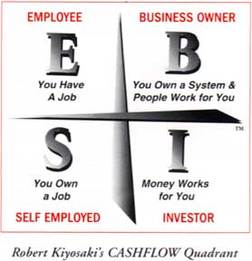
The Cashflow Quadrant is a diagram consisting of the four different types of people who make up the world of business. I must interject a little bit of opinion. This diagram is absolutely brilliant. It is a clear and simple way to understand the four ways in which money is made in America. Kiyosaki says that the people in each quadrant have a different set values which attracts them to that quadrant. He goes on to say that you can always tell the mindset, and values, a person has by the words they use.

Here's a copy of The Cashflow Quadrant. I'll quickly explain each quadrant.


Left side of the quadrant:

E stands employee – This is your typical 9-5 occupation. These are people that are primarily interested in security. A person from this quadrant can be heard saying the following, “I'm looking for a safe, secure job with good benefits.”

S stands for self-employed, small business, or specialist – These people often say, ”If you want something done right, you gotta do it yourself.” This is where you will find the world's hardcore perfectionists.

Right side of the quadrant:

B stands for big business – These are the people that are primarily motivated by freedom. They say things like, “I'm looking for a great system and great people to work for me.” They are the ones that hire the E's and S's.

I stands for investor – This is the quadrant where true wealth is created. These people invest in the B's of the world. These people say, “I don't work hard for money, my money works hard for me.”

Robert's Rich Dad would warn him to beware of money's addictive power. People don't simply work at their job because of desire or habit. It's more like an addiction. The reason so few people successfully switch quadrants is because switching is akin to breaking that addiction. The effects of the withdrawals are just too powerful.

Here are a couple of important dates that Kiyosaki points out. These events have drastically affected the way money works in America. The first was in 1971. It was in 1971 when President Richard Nixon took us off the gold standard. This meant that the quantity of our money supply was no longer anchored to a quantity of gold. This turned our money into a fiat currency which the government can print at will. The result is, “Savers are losers.”

With the Federal Reserve printing lots of money we see inflation and a declining value to the dollar. For this reason, it is no longer a good strategy to simply save money. A much better idea is to invest your money and, to do that, you need education. Kiyosaki is not a big fan of mutual funds. He views them as very risky. Mutual funds are purchased from salespeople, in the S quadrant, not investors. Mutual funds are sanitized securities that operate by a strategy of diversification (Warren Buffett calls it de-worse-ification.) Buffett and Kiyosaki say the intelligent investor operates with concentration and focus.

A lot of people believe that investing is risky. But, as Kiyosaki is fond of repeating, “Investing is not risky. Being uneducated is risky.”

In actuality, your hand has already been called, and you might not even know it. It is very likely you will need to become an investor. The reason for this is a law Congress passed in 1974 called ERISA. You may not be familiar with the name but you're probably aware of the outcome. Before ERISA we had what are called defined benefit (DB) pension plans. DB plans pay retirees a guaranteed monthly income until the end of their days. After the passing of ERISA, we now have defined contribution (DC) pension plan, such as IRA's and 401(k)s. The pay-out of DC plans are dependent on the preceding pay-in.

What's more, this shift will cause people to be responsible for their own investments. This idea may sound innocent enough but, here's the problem. People will need to begin operating from the I quadrant. Unfortunately, most people do not currently possess the skill set of of an investor (remember how Kiyosaki said that's the problem with mutual funds?) In his book Prophecy, Robert talks about how this shift, from DB to DC pension plans, will result in the, "Biggest stock market crash in history." His predicted crash will result from unskilled, uneducated people operating as investors.

The previous two examples, 1971 and 1974, illustrate the changing landscape of the world of money. We can chose to put our heads in the sand, ignoring what is happening, and hope for the best. Or, we can get involved, participate in the coming changes, and take control of our lives.

The Tax Reform Act of 1986 eliminated most of the benefits that came with being in the S quadrant. And, the E quadrant is an even worst place to get rich. One of the main reasons are taxes. In 1943 the government began collecting taxes through payroll deductions (thank you Milton Friedman.) In this way, the government makes sure they get paid first. The E quadrant really gets hammered. Not only do they pay taxes first. They also have to pay the most taxes, as far as percentages go.

The path that Kiyosaki suggests, for financial freedom, is the following. If you are an E or an S, get yourself successful in the B quadrant. Then take your excessive cash flow and invest in the I quadrant.



The test of a big business is the following: Can you walk away from your business, for a year or more, and come back to find it as successful, or even more successful, than when you left? If you can honestly answer yes to that question, congratulations, you're a successful B!

Kiyosaki also says that the B stands for Bill, Buffett, and Branson. Meaning, people like Bill Gates, Warren Buffett, Oprah Winfrey, and Richard Branson are true B business owners. But, to create a Microsoft, Berkshire Hathaway, Harpo Productions or Vigin would take many millions of dollars, and lots of time. Two resources very few of us have. Luckily Kiyosaki offers an alternative, network marketing. After much research Robert has concluded that network marketing, as known as multi-level marketing, is the best way for most people to follow his suggested path to financial freedom.

Kiyosaki says, "To be successful in the B or I quadrant requires financial intelligence, systems intelligence, and emotional intelligence. These things cannot be learned in school." For financial intelligence one could (and should) study Mr. Kiyosaki. Robert says that one of the main reasons most people never get rich is because they can't gain mastery over their emotions. He says that most people are ruled by fear and greed, which keeps them stuck in the Rat Race. To help gain control over our emotions Kiyosaki suggests reading Emotional Intelligence by Daniel Goleman. I have written an overview of this book. So, if I haven't already, I will soon post it to this blog. In Cashflow Quadrant, Kiyosaki doesn't suggest a book to learn systems intelligence. However, please allow me the liberty of suggesting a book for you. It was written by the MIT professor of management, Peter Senge. The book is titled The Fifth Discipline. Like Goleman's book I have written an overview of Senge's book. And again, if I haven't posted it yet, I will soon.

Mr. Kiyosaki gives financial advice that is quite different from the majority of advisors. I'm talking about people like Dave Ramsey and Suze Orman. They're both into the old school way of investing, the orthodoxy. In the old school it's about saving and getting out of debt. This is probably the best strategy for the majority of Americans. But Robert takes a different approach. Kiyosaki's advice is summed when he says, "Live within your means and then increase your means." Translation, Robert doesn't believe in cutting out that Starbucks latte or whatever. Kiyosaki says he likes driving his Lamborghini and he isn't going to apologize.

The implications of Kiyosaki's Cashflow Quadrant range far and wide. I couldn't possibly explain them all in this short overview. If you'd like further information or clarification just get a hold me me. I'll end with a detailed Cashflow Quadrant:


What can you do with this information right now?

Very simply, embrace the cashflow quadrant. Do whatever it takes to understand and internalize the teachings of this book. You might even have to read the whole book. But, I can assure you it's worth it. Once you comprehend Kiyosaki's genius you will begin to see the world through a completely different lens. One of my favorite quotes comes from the French author Marcel Proust. He said, "The real voyage of discovery consists not in seeking new landscapes but in having new eyes." Remember, money is just an idea. So if you want more money, you need better ideas. Get to become a B business owner. According to Robert Kiyosaki and Donald Trump, the best option for most people, is to join a network marketing company. This way you can keep the job you have, while learning Rich Dad's lessons on the side. If you ask nicely, I might let you join me. :)


Monday, February 24, 2014

Book Review: Rich Dad Poor Dad

This is an overview of the book Rich Dad Poor Dad by Robert Kiyosaki
This is the first book in the trilogy of Rich Dad books.


Kiyosaki's bio: Mr. Kiyosaki is a fourth generation Japanese American who was born in Hilo, Hawaii in 1947. He graduated for from the US Merchant Marine Academy and served as a helicopter pilot in the Vietnam war. Robert is an investor and educator and founder of the Rich Dad company whose stated mission is to, “Elevate the financial well-being of humanity.”

Key point: “The idea that it takes money to make money is the thinking of financially unsophisticated people. Money is only an idea.”

This is a book about personal finance. The book says this about itself, “Rich Dad Poor Dad is a true story on the lessons about money that Robert Kiyosaki learned from his two 'Dads.' One Dad, a PhD and Superintendent of Education, never had enough money at the end of the month and died broke. His other Dad dropped out of school at age 13 and went on to become one of the wealthiest men in Hawaii.”

The first dad, who had the PhD, and worked for the government, was Robert’s biological father. He worked all the time, and yet, was always stressed about money. The other dad, who dropped out of school at 13, was Robert’s best friend’s father. This second dad was able to use the extra time he had, from being rich, to teach the boys as they were growing up.

So the story is a tale of contrasting views towards money. For some, money has a sort of evil connotation. Where the explicit pursuit of money is an unholy act. These are people that might be taking the Bible a little too literally. In Matthew it is written that, "It is easier for a camel to go through the eye of a needle than for a rich man to enter the kingdom of God." Some people even believe that money is the root of all evil. 

Other people take a more receptive approach to money. These people take the perspective that money is something they have always used, and it is something they will always use. So they figure they might as well learn about it.  Kiyosaki was able to study both sides of the equation and has decided to go with the latter. That is to say, Robert listened to his rich dad. This book details the beginning of Robert's financial education.

As a youngster Robert was taught six lessons about money. And these six lessons now form the core of his book. I will briefly discuss each one. By the way, the lessons Kiyosaki teaches are the lessons of his Rich Dad so I use the two names interchangeably.

Lesson One – The Rich Don't Work for Money
Kiyosaki says, “The poor and the middle class work for money. The rich have money work for them.” Robert says that most people are stuck in what he calls the Rat Race. The reason for this is most people are hamstrung by their lack of control over their emotions. Rich Dad would say, “The pattern of get up, go to work, pay bills, get up, go to work, pay bills ... Their lives are then run forever by two emotions, fear and greed. Offer them more money, and they continue the cycle by also increasing their spending. This is what I call the Rat Race.”

Lesson Two – Why Teach Finanical Literacy?
“Intelligence solves problems and produces money. Money without financial intelligence is money soon gone ... Rule One. You must know the difference between an asset and a liability, and buy assets. If you want to be rich, this is all you need to know. It is Rule No. 1. It is the only rule.” The definitions are really quite simple. An asset is anything that puts money into your pocket. A liability is anything that takes money out of your pocket.

Lesson Three – Mind Your Own Business
Rich Dad taught Robert that if he wanted to become rich he would need to own (mind) his own business. “For adults, keep your expenses low, reduce your liabilities and diligently build a base of solid assets.” This doesn't mean you can't have nice stuff. It simply points out, “An important distinction is that rich people buy luxuries last, while the poor and middle class tend to buy luxuries first,” on credit. Rich Dad would say, “Let your assets buy your luxuries.”

Lesson Four – The History of Taxes and the Power of Corporation
“The reality is that the rich are not taxed. It's the middle class who pays for the poor, especially the educated upper-income middle class … Employees earn and get taxed and then try to live on what is left. A corporation earns, spends everything it can, and is taxed on anything that is left. It's one of the biggest legal tax loopholes that the rich use.”

Lesson Five – The Rich Invent Money
There are many ways the rich invent money. One example would be to purchase raw land, get it rezoned and sell it to real estate developers looking to build homes or a shopping mall. Another way is trading stocks, in particular, buying stocks of a pre-IPO company. Unfortunately, many of the best stocks aren't available to the average investor. In an attempt to curtail junk bond salesmen the SEC created a classification system for securities. The result was that it now requires too much work for most pre-IPO companies to seek investments from average investors. It usually makes more sense to go to a syndicate of “sophisticated” investors. (note: the Jobs Act of 2012 has changed this)

Lesson Six – Work to Learn – Don't Work for Money
Rich Dad would often say that it isn't money that makes you rich, it's business skills. And, the single most important business skill is selling and communicating. It is for this reason that Kiyosaki often recommends a network marketing company, also known as multi-level marketing. MLM's focus on training and developing their people. Specifically in the areas of selling, communicating, and leadership. So, first wealthy people learn and develop the skills. Then they get the money. The poor want to be paid while they're being trained.

Kiyosaki sees five main obstacles, that people must overcome, if they wish to be rich. They are: fear, cynicism, laziness, bad habits, and arrogance.

To get us moving, Robert concludes by saying, “I offer you the following ten steps as a process to develop your God-given powers.”
1. I need a reason greater than reality – The power of spirit.
2. I choose daily – The power of choice.
3. Choose friends carefully – The power of association.
4. Master a formula and then learn a new one – The power of learning quickly.
5. Pay yourself first – The power of self-discipline.
6. Pay your brokers well – The power of good advice.
7. Be an “Indian giver.” - The power of getting something for nothing.
8. Assets buy luxuries – The power of focus.
9. The need for heroes – The power myth. Emulate your heroes.
10. Teach and you shall receive – The power of giving.

I'll end back where I began. Many people believe it takes money to make money. Kiyosaki thinks this is foolish. “The idea that it takes money to make money is the thinking of financially unsophisticated people. Money is only an idea.” To make more money takes better ideas. Kiyosaki would say we derive betters ideas from being more educated. Specifically in the area of financial intelligent.

How can you use this information right now?

Mind your own business. If you don't already own your own business you need to. ASAP! According to Robert Kiyosaki and Donald Trump, the best option for most people, is to join a network marketing company. This way you can keep the job you have while learning Rich Dad's lesson on the side. If you ask nicely, I might let you join me. :)


Monday, February 17, 2014

N = 1


We've all heard the saying, “If you don't learn from history, you're bound to repeat.” This post is all about learning from history. I was thinking of naming this post, “Live Experimentally.” But I really like the elegance of N=1. N=1 is about self-experimentation. Although, you can do what you want, I'm not really talking about, “Sex, Drugs and Rock 'n Roll.” I'm talking about everyday stuff. I'm talking about learning from our experiences so we can repeat the ones that work and fix the ones that don't.

Is it coincidental that the words “experience” and “experiment” are so similar? Definitely not. I saw an article, on the website of the Worcester Polytechnic Institute, that said, “An experiment is what you do to investigate something. It is the process by which you learn something … An experience is something that happens to you.” As you can see, the only really difference is the intent. If your goal is to learn something, you're leaning towards an experiment. If you're just coasting, and letting things happen, you're in the realm of experience. Both are useful. But, again, this post is about learning. So, we need to learn how to set up an experiment.

As you probably know, the letter N denotes the sample size in a scientific experiment. N=1 means a self-experiment. We most certainly cannot draw general conclusions from self-experimentation. However, we can definitely increase our effectiveness. The goal of N=1 is to become more effective. It's not to figure out some advice that we wish to impart on others. For the most part, you're probably going to want to keep your results to yourself. So, let's take a step back and review the scientific method.

I won't get real deep into it, let's just keep it simple. Science is fueled by curiosity. The first step is experience. Experience is an integral part of experimentation. Through our experiences, and observations, we wonder about the way the world works. We do a little bit of investigation so we can establish our viewpoint. This is our hypothesis. If we're smart, we test our hypothesis by running an experiment. Then we review the outcomes (the data) of our experiment to see if the hypothesis was wrong (you can never really prove that a hypothesis is “right.”)

If the hypothesis is proven to be incorrect, we throw it out and come up with a new one. That is to say, we come up with a new theory. Conversely, if the hypothesis is supported by the evidence, we want to tweak one variable and rerun the experiment. This is critically important. Ultimately what we looking for is something called the “mechanism.” I won't get into it other then to say that you want to change your variables one at a time. This will allow you to establish which is the key variable. What we're looking to do is distinguish between correlation and causation. Meaning, it decipher between what is cause versus what is merely connected.

This is something we all do rather intuitively. Let me give you an example. For the most part, people get sun-burned when it's warm outside. So, if we don't know how isolate our variables, we might think that warm weather causes the skin to burn. Of course, all we have to do is change one variable at a time to see if that hypothesis (warm weather burns) is accurate. A simple way of doing this would be to wear the same clothes, on a different warm day, and stay out of the sun. It doesn't take long to figure out that the sun is the culprit. The sun is the mechanism that burns skin. Had we put on a lot on clothing AND stayed out of the sun, we wouldn't know which is which. Changing two variables is of no help.

In the jargon of science, warm weather is correlated with burnt skin and the sun causes burnt skin. This is a distinction that messes a lot of people up. Of course, I intentionally used a very simple example to illustrate the point. We all know that warm weather doesn't cause sun-burns. You don't have to understand electromagnetic radiation to know that the light, coming from the sun, is what fries our skin. Incidentally, I am, in no way suggesting that you stay out of the sun. Sensible sun exposure is an important part of overall healthy living.

What I'm saying is to live experimentally. Practice is pretty much all that's required. With time, it becomes second nature to isolate your variables. Of course, sometimes changing one variable at a time is impossible. But there are all kinds of ways to construct personal experiments to figure out what's working, in our lives, and what's not.

I guess there's something of a paradox here. In science you generally want N to be as big a number as possible. In other words, you want as large a sample size as possible. Statistics teach us that the larger the sample size, the more reliable/accurate the data. However, if you know how to conduct proper experiments, and not be fooled by chance, you can get the best information from N=1. So, good luck and happy testing.


Monday, February 10, 2014

Don't Trust Yourself


I guess I'll go ahead and clarify, a little bit, right off the bat. More thoroughly, the title of this post probably should have been, “Don't always trust yourself.” And, it's good advice. Sometimes we should, indeed, trust ourselves. But, not always. You see, a lot of people seem to be very proud that they, “Go with their gut.” And I would agree that instincts, or gut feelings, are often accurate. But, they're often wrong, as well. Let me explain.

Many years ago, psychologist Aaron Beck founded a scientific discipline called Cognitive Therapy. One of the many things Beck did was identify a phenomenon that he called a “Cognitive Distortion.” It's not a term we hear every day but, perhaps we should. It's a really important idea. Instead of using the technical, psychological jargon, let's just call it a “Thinking mistake.” The fact of the matter is, we humans make thinking mistakes all the time (humbling though that may be.) In fact, we often make these mistakes in regular patterns. So much so that Dan Ariely felt inclined to write a book titled Predictably Irrational. It's a jolly good read. If you haven't read it, I highly recommend doing so.

Any how. The thinking mistake that has been on my mind lately, is something Beck would call, “Emotional reasoning.” The thought process, behind emotional reasoning, goes something like this, “I feel it, therefore it must be true.” For example, let's say you totally over sleep one day. You wake up and frantically run around the house trying to get the kids ready for school. The thoughts swirling in your head are, “How could you do this? You're such a bad mom. This kids are counting on you and all you can do is selfishly snore the days away. You should be ashamed of yourself!”

This is an example of emotional reasoning. That morning, when you looked at the alarm clock and realized your kids were an hour late for school, you started to beat yourself up. You went so far as to label yourself a bad mother. The reasoning was emotional. It goes something like this, “Oh, I feel so guilty, I must be a bad person.” You see, a lot of people, when they feel the emotion of guilt, automatically assume they must have done something wrong. So, you scurry around the house throwing sharp, mental daggers at yourself. You get so caught up in your self-imposed torture that you can't even hear your children trying to tell you it's Saturday.

Now, that might seem like a silly example, and perhaps it is. But these sorts of scenarios are all too common in modern life. The following is how the book Thoughts & Feelings explains emotional reasoning, “You believe that what you feel must be true-automatically. If you feel stupid or boring, then you must be stupid and boring. If you feel guilty, then you must have done something wrong. The problem with emotional reasoning is that our emotions interact and correlate with our thinking process. Therefore, if you have distorted thoughts and beliefs, your emotions will reflect these distortions.”

In the example of the late-rising mother, the problem was her assumption that it must be a weekday. Which is a totally understandable assumption, seeing as the majority of days (71%) are weekdays. It just so happens that this particular day wasn't one of them. It was a Saturday and there was no school. I used that example because it's innocent enough. However, as it turns out, these sorts of thinking mistakes are quite common. And so, we need to be on-guard against them.

One place where it's most obvious that we shouldn't always trust ourselves is with our diet. This is a realm that often leads to some rather delicious paradoxes. One thing I often say is, “I love dessert. That's why I don't eat it.” Get it? It's a total paradox but it makes sense, doesn't it? It's easy to get carried away eating sugary treats. My love for desserts keeps me on-guard against them. It's not that different from how an alcoholic should not go into a bar. Just because we feel like eating or drinking something, doesn't mean that we should. Again, it's not always a good idea to trust your feelings.

One of Aaron Beck's students was a gentleman named David Burns. Dr. Burns says that procrastination is one of the most common side effects of emotional reasoning. Which makes all the sense in the world. I can tell you this, I don't know that I've ever felt like taking out the garbage. And I've damn near earned a PhD in procrastination. But, it must be done, so we do it. Right?

Another psychologist, David Reynolds, puts it like this, “The mature human being goes about doing what needs to be done regardless of whether that person feels great or terrible. Knowing that you are the kind of person with that kind of self-control brings all the satisfaction and confidence you will ever need. Even on days when the satisfaction and confidence just aren’t there, you can get the job done anyway.”

Maybe that tag, those three words, will sick in your head. Don't trust yourself. (Three more common words would be Do It Now.) I mean, you shouldn't, necessarily, listen to your feelings. Sometimes ya gotta do what ya gotta do. You have to force yourself. Get out of your comfort zone. Like meeting new people. It can be quite uncomfortable. But that's certainly no reason to not do it. (Are double negatives allowed? I always forget.)

I think this whole listening-to-your-emotions thing was parodied beautifully in that Sprint commercial with James Earl Jones and Malcolm McDowell. You know the one? The one where they reenact a text conversation between two guys named Chris and Craig. “I'm kinda tired, but I also kinda wanna go out … Me too!! ….Well, text me if you do … K. But, I probably won't. But I might.”

Too funny!!

Have a good one :)

Monday, February 3, 2014

Embrace the Genius


Let me ask you a question, is life a marathon or a sprint? I'm being serious. What do you think? Is life like a sprint or a marathon? Please take a minute and think about it. You probably don't need much time. I have to imagine that you answered the question, in your mind, immediately after you read it. But, perhaps, you waffled. Maybe you rethought the question and began to come up with good arguments for either answers. Let's talk about the answer. But first, let's take a step back.

Last week I posted an idea from the book Good to Great. Specifically, I talked about something Jim Collins had named "The Stockdale Paradox." And this week, I figured I'd mention something from another of Collins' books, Built to Last. If you have no idea what I'm talking about go here: My Favorite Subject

As the title of this website suggests, I think and study a lot about paradoxes. And it's not because I'm a glutton for punishment. But rather it's because paradoxes are central to life. F. Scott Fitzgerald was essentially speaking about the paradox when he said, “The test of a first-rate intelligence is the ability to hold two opposed ideas in the mind at the same time, and still retain the ability to function.” Now, I'm not saying I have a first-rate intelligence, but I am working on it. :)

Built to Last is an excellent book and I highly recommend it to you. I'll probably end up posting a report about the entire book. Or, I might just take the concepts one at a time. I haven't decided yet. But I have been fortunate enough to work with Collins' co-author on some of the concepts in Built. One concept, in particular, has been ringing in my head lately.

Built to Last is a book about the successful habits of visionary companies. In their research, what Collins, and his co-author Jerry Porras, discovered was that visionary companies do not oppress themselves with what the authors call the “Tyranny of the OR." The "Tyranny of the OR" is the rational view that cannot easily accept paradox, that cannot live with two seemingly contradictory forces or ideas at the same time. It pushes people to believe that things must be either A OR B, but not both.

“It makes such proclamations as: You can have change OR stability. You can be conservative OR bold. You can have low cost OR high quality. You can have creative autonomy OR consistency and control. You can invest for the future OR do well in the short-term. You can create wealth for your shareholders OR do good for the world.” That last one is actually pretty popular these days. It's the idea behind, “Doing well by doing good.” A great example would be Yvon Chouinard and what he's doing with Patagonia.

Collins and Porras found that instead of being oppressed by the “Tyranny of the OR,” highly visionary companies liberate themselves with the “Genius of the AND.” This is the ability to embrace both extremes of a number of dimensions at the same time. “Instead of choosing between A OR B, they figure out a way to have both A AND B.”

This isn't about greed but rather it's about wisdom. Automobile manufacturers used to believe that you could either produce a low-cost car OR a high-quality car. And that's exactly what they did. But then one company wondered if they could do both. Before long, Toyota had taken over and was in first place. Today it's well accepted that we can have low-cost AND high-quality. In fact, in many ways, high-quality IS low-cost. What we find is that higher quality goods actually cost less. It's like my pappy used to say, “Anything worth doing is worth doing right the first time.”

Let's take it off business for a minute. Let me ask you this, would you consider yourself Dr. Jekyll or Mr. Hyde? By making the question personal, I hope to have illustrated the point. The answer, that I imagine you gave, was something like, “It depends.” And, yes, it does depend. You're probably more Jekyll than Hyde but we all have the ability to be both. We're good AND we're bad. If you doubt me, or if you're in denial, I encourage you to read the book The Lucifer Effect by Phil Zimbardo. The book is about the famous Stanford prison experiment and it clearly illustrates how each of us is part Jekyll and part Hyde. My friend, don't fight it. It is what it is. Embrace the genius of AND.

Let's finish back where we started. What was the question I first asked you? Is life a marathon or a sprint? What is your answer now? Surely, your answer now is that life is both a sprint AND a marathon, right? I believe that's true. I believe it's wise to view life as a marathon of sprints. “Hurry up and wait,” right?

I do think the marathon element is the more fundamental of the two. But both are important. Grit and perseverance are critically important in life. However, procrastination is also an ever present enemy. This is where the sprint comes into play. Sometimes we need to get off our butts and sprint. It's how great things get done. Of course, we can't sustain a sprint indefinitely. So, sometimes you need to sprint and sometimes it's okay to walk. New York psychologist, Nando Pelusi, likes to use the word “Kurtosis” for this process. Dr. Pelusi advocates a strategy of brief intervals of passionate, intense activity dispersed among periods of conscious relaxation. Basically, a marathon of sprints.

P.S. I highly encourage you to read the book Built to Last. It's quite impressive and it launched Collins into an extremely successful career. You've probably heard Jim's name before. But, the name you definitely hear the most, on this blog, is Peter Drucker. Here is what Collins had to say about Peter, “My first encounter with Drucker's impact came at Stanford in the early 1990's, when Jerry Porras and I researched the great corporations of the twentieth century. The more we dug into the formative stages and inflection points of companies like General Electric, Johnson & Johnson, Procter & Gamble, Hewlett-Packard, Merck and Motorola, the more we saw Drucker's intellectual fingerprints. David Packard's notes and speeches from the foundation years at HP so mirrored Drucker's writings that I conjured an image of Packard giving management sermons with a classic Drucker text in hand. When we finished our research, Jerry and I struggled to name our book, rejecting more than 100 titles. Finally in frustration I blurted, "Why don't we just name it Drucker Was Right, and we're done!" (We later named the book Built to Last.)” I'm just sayin'.


Monday, January 27, 2014

My Favorite Subject


Several years ago Jim Collins wrote a very influential business book titled Good to Great. The idea was to study great companies. Actually, it was a little more complicated than that. You see, Collins had already done a study of great companies. And the results were published, along with his coauthor Jerry Porras, as a book titled Built to Last. The companies in Built had essentially been great from inception. These were companies like HP and Merck.

Then one night at dinner Bill Meehan, a managing director for McKinsey & Company, leaned over and asked Collins about the companies that weren't spectacular from birth. Meehan was asking about, “the vast majority of companies that wake up partway through life and realize that they're good, but not great.” Collins understood the point. And it led him to ask the questions, “Can a good company become a great company and, if so, how? Or is the disease of 'just being good' incurable?”

This post isn't really about the book Good to Great. Perhaps I will post a book report someday, but not today. Specifically, I wanted to talk about just one of Collins' findings. Collins, and his team, found that companies who make the leap from good to great embrace a certain cognitive tension. It's a mindset that Collins called “The Stockdale Paradox.”

James Stockdale, “was the highest-ranking United States military officer in the 'Hanoi Hilton' prisoner-of-war camp during the height of the Vietnam War. Tortured over twenty times during his eight-year imprisonment from 1965 to 1973, Stockdale lived out the war without any prisoner's rights, no set release date, and no certainty as to whether he would even survive to see his family again,” writes Mr. Collins.

In the later years of his life, Admiral Stockdale was a senior research fellow, at the Hoover Institution, where he studied the Stoic philosophers. As it turned out, this was during the same time that Collins was a professor at Stanford. One day Stockdale invited Collins, and one of his students, out for lunch. Having read Stockdale's book In Love and War, Collins knew of the experiences the Admiral went through while interned in Vietnam. Stockdale's story had Collins feeling quite depressed. He wondered how anyone could have survived such an ordeal. Their lunch date gave Collins the opportunity to ask.

“I never lost faith in the end of the story,” is what Stockdale said. “I never doubted not only that I would get out, but also that I would prevail in the end and turn the experience into the defining event of my life, which, in retrospect, I would not trade.” Collins pondered the statement for a minute and asked, “Who didn't make it out?” Stockdale replied, “Oh, that's easy. The optimists.”

Collins said he didn't understand how that could be. To which Stockdale said, “The optimists. Oh, they were the ones who said, 'We're going to be out by Christmas.' And Christmas would come, and Christmas would go. Then they'd say, 'We're going to be out by Easter.' And Easter would come, and Easter would go. And then Thanksgiving, and then it would be Christmas again. And they died of a broken heart.”

There was another long pause and then Stockdale turned to Collins and said, “This is a very important lesson. You must never confuse faith that you will prevail in the end–which you can never afford to lose– with the discipline to confront the most brutal facts of your current reality, whatever they might be.”

Collins writes, “To this day, I carry a mental image of Stockdale admonishing the optimists: 'We're not getting out by Christmas; deal with it.'” And this led Collins to the creation of The Stockdale Paradox. Collins states the paradox as follows, “Retain faith that you will prevail in the end, regardless of the difficulties. And, at the same time, confront the most brutal facts of your current reality, whatever they might be.”

Far be it from me to question Admiral Stockdale but I think his use of the word “optimist” is misplaced. The story kind of downplays the importance of optimism. And, as we know, Martin Seligman has shown, beyond any reasonable doubt, the usefulness of optimism. When Stockdale spoke of, “faith in the end of the story,” he was clearly demonstrating a form of optimism. The people that didn't make it out of the Hanoi Hilton, if they were optimists at all, were a kind of delusional optimist. What's needed is what Heidi Grant Halvorson would call, “Realistic Optimism.” It's a sort of grounded optimism. And, it's the essence of The Stockdale Paradox. It's having faith in the end game while, simultaneously, being aware of current reality. It's the sort of groundedness that is the essence of the eastern philosophy of Mindfulness.

When asked what the hardest part of being an entrepreneur was, Jack Harding replied, “Persistent failure.” If you have ever built a business you understand why Harding would say such a thing. Building a successful business involves one mistake after the next. The key is resiliency or what Dan Pink would call, “Buoyancy.” Understanding, and embracing, The Stockdale Paradox is at the core of resiliency and perseverance. Because one of the core paradoxes of entrepreneurialism is that, "we fail our way to success."


Monday, January 20, 2014

The only reason your business exists...


As you have probably noticed I think, and talk, a lot about Peter Drucker. And for good reason! He was the man. People really do need to know more about Peter's teachings. Especially business people. This week I thought I would take it back to the fundamentals of business.

I have read a great many business books and a lot of them can be rather complex. Seeing as we live in a complex world, it makes sense that these books are complicated. But it's also wise to try to keep things simple. Leonardo da Vinci is quoted as saying, “Simplicity is the ultimate sophistication.” It's a yin and a yang. Indeed, it's a paradox. As paradoxical as it sounds, it's actually quite hard to keep things simple.

In all the books I have ever looked through, there was only one that asked the question, “What is a business?” Now, that may seem like a ridiculously obvious question. But I don't think it is. I think answering that question is the simplicity which is the ultimate in complexity. Below I have included a scan from Drucker's magnum opus. And I'll never forget the day I first read this chapter. It was profound.


Drucker says that THE most important question you need to ask is, “What is our business?” And, as simple as I know that question may sound, it's wonderfully difficult to answer. Indeed, most people get it wrong. Let's say you work for Microsoft. If you say your business is software, sorry, but you're wrong.

Another example is the medical field. Most people, who work in the medical profession, would say their business is, "Health care." And they'd be wrong. Healthy people, as a rule, are not admitted into the hospital. By definition, a more accurate statement is, "Sick care." And, even the phrase “sick care” would be far from sufficient. This is something I wrote about here: Assurance to the Afflicted

Back to the more fundamental question, “What is a business?” Tell me, what do you think? Take a minute and think it through. Better yet, take out a piece of paper and write out your answer. I promise you, it's an excellent investment of your time. So go ahead, I'll wait...

Now, hopefully you did spend a minute on Drucker's question. Few people clarify what A business is and, more particularly, what THEIR business is. And this is probably the single largest cause of business failure. Drucker calls the answer to the question your, “Theory of business.” The cool thing is that you can get your theory of business “wrong” and not be a failure. How? By adjusting and tweaking, of course. If the theory is wrong, scrap it and get a new one. Make adjusts. The key to business, indeed, the key to life is adaptability.

Before I leave you to your thoughts, allow me to answer Drucker's question for you. The question I am referring to, of course, is, “What is a business?” I couldn't possibly tell you what YOUR business is, because all sorts of people are reading this post. But, the general question I can answer. If you look closely at that image, taken from Chapter 6 of Drucker's book, you will see the following phrase, “The Purpose of a Business: To Create a Customer.” As obvious as that may seem, it's amazing how many people get it wrong.

A fair number of people believe that a business exists to make a profit. Which is getting the sled in front of the dogs. Even the supposed business elite think in these sorts of terms. On Wall Street it's fairly popular to talk about, “Maximizing shareholder value.” Indeed, quite a number of companies have that very phrase in their mission statements. For these people, the sled pulls the dogs.

Peter Drucker, and later Stephen Covey, would remind us to keep, “First things first.” The proper order is to keep your focus on the realities of your customer. You need to create real value for people. When all is said and done, business is nothing more than the exchange of valuable things. You produce something customers value. And, in return, your customers give you something you value. Namely, cash money. And, voila, you have fulfilled the purpose of a business by creating a customer.

This is non-trivial because understanding the true nature of business allows you to understand the actions you must take. Going back to that image, from Drucker's book, you will see the phrase, “The Two Entrepreneurial Functions: Marketing and Innovation.” By pin-pointing the purpose of a business, we have identified our two main tasks.

There are several ways to conceive of marketing, and we will discuss them over time. There exists many models to draw upon when constructing your marketing strategy. These include the 4 P's, STP, and even Phillip Kotler's ME. Again, these are discussions for another day.

As far as innovation goes, again, I won't get into it here. All you need to know is that innovation is about creating customer value. It is something I have written about, at length, on the following website: The Future That is Already Happening

So, hop to it. Please. Take the time and answer the question, “What is our/my business?” And, don't say you sell photocopiers, or pharmaceuticals, or houses. Trust me, that's NOT your business. If you need some help, again, I would encourage you to read this post: Assurance to the Afflicted

What you're basically trying to answer is the following question, "What need/desire do I satisfy for my customers?" Looking at your business through the eyes of your customers is wonderfully useful. But, I must tell you, it ain't easy. It's hard, hard work. So please, get started today!


Monday, January 13, 2014

The Millionaire Real Estate Agent


This is an overview of the book The Millionaire Real Estate Agent by Gary Keller


Mr Keller's bio: Gary established Keller Williams Realty, with partner Joe Williams, in 1983. Keller is a native of Houston, Texas and a graduate of Baylor University.

Key point: Run your occupation like a real business. And the goal of a real business is to have others successfully run it for you. In particular this book is about how to net a million dollars in income through a business that others run for you.

Mr. Keller speaks to the importance of keeping it simple. He quotes jazz legend Charles Mingus as saying, “Making the simple complicated is commonplace; making the complicated simple, that's creativity.” He goes on to talk about creativity. He says we should build our creativity on top of solid, proven models. To do it the other way around would be too hard and take too long.

Speaking about models, Keller talks about making it to the top of the real estate mountain when he says, “Once the path was identified, the journey became more accessible to others.” It is mentioned that doubts can truly undermine our efforts. Knowing that others have achieved the exact success we strive for allows us to model the behavior. In turn we increase our chances of achieving the results we strive for. Gary gives the example of Roger Bannister and the four minute mile.

It had long be thought that no human being could run a mile in less than four minutes. Australian miler John Landy had made numerous high-profile attempts but had come up short each time. Then along came British medical student Roger Bannister. Bannister broke the goal down into manageable pieces, a quarter of a mile is less than a minute. On May 6, 1954 Roger ran the “miracle mile” in 3 minutes and 59.4 seconds. What's equally interesting is that Landy came back to break Bannister's record in less than two months. Once the psychological barrier was torn down, and the sub-four mile was proven possible, Landy and many others were able eo accomplish the feat as well.

“The truth about ability is that it is neither set nor predetermined,” says Keller. This may seem obvious to some, but many people don't believe it. The Stanford psychologist, Carol Dweck, wrote an excellent book on the subject titled Mindset. If you believe Keller's quote, you're said to have a "Growth Mindset." If you disagree, you are said to have a "Fixed Mindset."  While this may appear to be an inconsequential idea, it turns out to make all the difference in the world. I can't get into it here but I will be posting an overview of Dweck's book soon.

Anyways. Keller talks about The Three L's of his real estate agent model. They are: leads, listings and leverage. Gary says that every professional – regardless of whether they're a doctor, lawyer or whatever – has two jobs: their chosen profession and lead generation. It could be argued that many people choose to work in big companies so as to keep from being responsible for the generation of leads. Meaning, the unspoken code is, “You find the work and I'll do it.” Hopefully they come to understand the price they're paying for such abdication. Often the real value is in the finding of the work.

Keller suggests that you think of yourself as being in the lead-generation business. “If you count on the market to deliver leads when times are good, you better count on it to take them away when times are bad.” Indeed, one of the main ways to prepare for the inevitable shifts in the market is to create and maintain a habit of prospecting (lead generation). Gary says, “The ones who look like marketing and prospecting geniuses do it consistently over time and meticulously track and source their leads...For all its creativity and art, the part of marketing and prospecting that is science always rules.”

So Keller is saying that leads generation comes first, last and always. And the leads that you should be most focused on are seller-listing leads. Listings just flat produce more income than buyers. In the book Gary lists what he calls, “The Many Virtues of Seller Listings.” They are:
1. Seller listings mean marketing opportunities:
a) You get to put your sign in the front yard (and maybe directional signage, as well).
b) You get to market the listing through direct mail and email, etc.
c) You get to advertise the listing through newspapers, magazines, the MLS, your website, etc.
2. You have more control of your time. There is usually not the sense of do-it-right-now urgency with sellers that buyers often have. As such, you should be able to control your schedule a little better.
3. Seller listings maximize your per-hour compensation. It usually takes a lot less time to obtain and market a listing prior to its selling. More time consuming is showing and selling property to a buyer.
4. Volume, volume, volume. In Keller's experience a highly focused, highly leveraged real estate agent can work fifteen to twenty-five seller listings per month. And keep it up. The same agent would be hard pressed to work seven or eight buyers per month, while continuing to do so over a long period of time.
5. With seller listings you are on the front end of pricing, which translates into an intimate knowledge of the market.
6. Properly marketed seller listings bring you more business. Because of the multiple marketing
opportunities that are part of the listings process, Gary has found that on average, one well-marketed listing will generate one serious buyer who buys. So, if you focus on obtaining and marketing seller listings, you should be able to get all the buyers you need. It's the real estate industry's version of the “twofer.”

The last of The Three L's is leverage. Leverage is about three keys areas: people, systems and tools. Keller counsels, “Until you have maxed out on what you can accomplish through focus on leads and listings, you should not be hiring another person.” But, once you've got more on your plate than you can handle, you will want to hire help. The first hire will be the first piece of leverage and it should be administrative help. Obviously, such assistance will help with the load of administrative work. But also, this person will eventually help create and implement your systems, the second aspect of leverage. Keller clarifies, “Systems documentation is an ongoing process. It is never complete.”

Your documented systems are one of the tools of leverage which will allow you the freedom that comes with the passive income generated by your business. Two key pieces of advice are given and they are; one, know your numbers, and two, practice what Keller calls “Red Light, Green Light.” RLGL is where you take one step at a time and make sure that every expenditure pays for itself. Whenever adding an expense, hold it accountable and make sure it improves profitability. Whether it be an advertising expense or a new hire each expense needs to prove itself profitable before additional funds can be spent.

As you progress and grow your business make sure you are operating based on proven models. Gary quotes Warren Buffett as saying, “One learns through experience, and if not from experience, from those with experience.” You need to maintain a grasp of how the various aspects of your business interact to produce financial results. Obviously, this will help you practice Red Light, Green Light.

Keller references the legendary marketing book Positioning by Al Ries and Jack Trout. I won't explain this book too much. As you might have guessed, I have an overview written about Positioning as well. I plan to post it in the not-too-distant future. Suffice it to say, the marketplace is very congested with advertising messages. You need a strategy to get through all that clutter.

So, how do we fill up our sales funnel/pipeline with all the necessary leads. Keller says, “A strong marketing-based, prospecting-enhanced lead-generation plan backed by script and dialogue mastery is the best formula for creating the greatest number of leads for your business.”

As you probably know, your database IS your business. When marketing to your database you want to divide it into two groups: the people you've met and, the people you haven't. All the people you have met should go through the 8x8 and 33 Touch program. This means you will contact these people, once a week. for eight straight weeks. An additional 33 touches will come throughout the year.

From these efforts you should be receiving 2 closed deals for every 12 people you put through this program. Keller phrases it as 2 for 12 instead of 1 out of 6 because it should be one repeat sale and one referral sale. Remember to put the referred client back through the 8x8 + 33 Touch system.

For the group of people you have targeted but haven't met (including your farm) you will do the 12 Direct program. It stands for twelve direct mail pieces mailed out annually. From these efforts you should receive one closed deal for every 50 people you put through the 12 Direct program. And, of course, you want to take and put all new clients through the 8x8 + 33 Touch system. This may seem like an expensive endeavor. Gary encourages you to go ahead and do the math, based on expected commissions, and you'll see this system more than pays for itself.

Keller says the key to growing your business is to follow the four models and to focus on The Three L's. The four models are the following:
  1. Your Economic Model – where you'll invest your money and time
  2. Your Lead-Generation Model – 8x8 + 33 Touches and 12 Direct
  3. Your Budget Model – accounting and Red Light, Green Light accountability
  4. You Organizational Model – hire administrative help first, hire talent

As part of your organizational model, seller specialists are responsible for five key activities:
  1. Converting seller leads into appointments
  2. Making listing presentations
  3. Securing seller listings
  4. Handling communications during the marketing period
  5. Negotiating purchase offers

Similarly, your buyer specialist is responsible for six key activities:
  1. Convert buyer leads to in-office presentation appointments
  2. Make the presentations
  3. Secure the buyer listings
  4. Show houses
  5. Negotiate purchase offers
  6. Handle communications from contract to closing

Keller figures you need $2.4 million in Gross Commission Income (CGI) to net a million in income. That because you will need $700K for Cost of Sale (COS) and another $700K for Operating Expenses. The break down is as follows, CGI – COS – Operating Expenses = $1M. To achieve $2.4M you're going to need lots and lots of leads. Hence the reason Keller spends so much time on the subject.

The book finishes with advice on a personal level. Keller reiterates, “Your growth will actually come before the growth of your business.” He takes a minute and discusses the idea of a balanced life saying that it's basically an illusion. Especially if you wish to be a high achiever. Life will often see-saw between balance and imbalance. The key, Gary says, is to, “allow imbalance when key goals are at stake, but not to dwell in that state too long.” Keller calls this “counterbalancing” and says it's much more realistic than a so called “balanced life.”

Keller references a book by Michael Gerber called the e-Myth. In it Gerber talks about the difference between working “IN” your business and working “ON” your business. Working in your business means doing the tasks that are necessary to close deals such as showing property, negotiating, prospecting, etc. Working on your business entails the bigger picture that you allow you to walk away with ownership of a successfully operating business. Examples would be defining the mission, detailing your values, orchestrating the direction of the enterprise, leadership, etc. When it comes to leadership Keller finds it useful to remember the acronym MVVBP. Meaning that you want to bring five key things to your venture: Mission, Vision, Values, Belief and, Perspective.

Keller says, if you stay focused and utilize the energy that comes with continuous learning, you too can net a million.

How can you use this information right now?

Focus on The Three L's of real estate: leads, listings, and leverage. Stick to the basics because fundamentals win championships. As obvious as it may seem, treat your job like a real business. Some people may not like this idea but, the language of business is numbers. To the extent that you can understand and master your numbers, you will improve the results you're getting and, your life will get easier. This includes things like you conversation ratios. It also means holding all, non-fixed, expenses accountable for improving profitability.


Monday, January 6, 2014

A Revolutionary Idea


Like most people, I love America. I am EXTREMELY thankful to have been born in to such an amazing country. The land of the free and the home of the brave, right? Especially the free part. Freedom is one of the most powerful words in these United States. In fact, a lot of people would argue that the two words (America & Freedom) are synonymous.

My whole career, and the mission of my company, is to realize the dreams of our founding fathers. It's all about, “Life, liberty, and the pursuit of happiness,” like Thomas Jefferson said. But if you want to really understand America you will need to understand paradox. From its conception, so much of the United States has been paradoxical.

Let's just take one example, and why not make it about the country's patron saint? I am speaking, of course, about George Washington. As we know, Washington led the Continental army and was our first President. One thing you may not have thought about is that resolving paradoxes was one of the main keys to George Washington's greatness.

The paradox, which has been in my mind lately, has to do with the Revolutionary War. In colonial times, a lot of people believed that dedication, and conviction, were all it would take to defeat the British. The idea was that colonists, who were devotedly committed to “The Glorious Cause,” could defeat the seasoned mercenaries that made up the British armed forces. This romantic illusion persisted for quite a while. But events in New York City changed everything.

All across Long Island and Manhattan General Howe, and the British, kicked the crap out of the Continental army. It was so bad that Howe had a very real chance of winning permanent victory. But, for some reason, he chose not to tighten the noose. The events in New York confirmed what General Washington had long believed. The only way to defeat a standing army was by becoming a standing army.

Herein lies the paradox. The imposition of a standing army was the very thing that the colonists were rebelling against. The imperialism of the monarch was precisely what caused a million dollars worth of tea to get thrown in the harbor near Beantown. And yet George Washington was proposing the creation of a standing army. Talk about a tough sale!! I mean, how do you recruit people to become the very thing they despise?

Washington is arguably the most important of the Founding Fathers. That said, he certainly wasn't perfect. In fact he was a pretty lousy general. He lost more battles than he won. And the colonist's two main victories were largely attributable to other people. In the case of the Battle of Saratoga, Horatio Gates was in command. And it was the French that were running the show at Yorktown.

As it was, Washington initially had wanted to fight the British head-on. Being an extremely proud and courageous man Washington wanted to go at it mano-a-mano. New York City demonstrated what a disaster such a strategy would have been.

In spite of the seemingly overwhelming odds, they did it. The revolutionary soldiers defeated the far superior forces of the British crown. The fact that the colonists won has led many people to deify George Washington. As Washington himself has said, “Reputation derives its principal support from success.” Had the Americans lost the war, the name Washington would probably have meant very little. As it turned out, victory allowed Washington to name the federal city after himself. Or at least suggest naming it that way.

George Washington was a great man. And much of his deserved reputation stems from his ability to resolve paradoxes. Indeed, solving paradoxes is one of the key tasks of leadership. And Washington was definitely a great leader.

So, how did he do it? What did he do? Put yourself in his shoes. What would you have done? In today's post I figured I'd ask questions rather than give answers. The reason being, this sort of mental exercise is quite useful. Actually, I can't think of an exercise that is more valuable than the practice of solving paradoxes. Difficult though they may be.

So, chew on it. Please. How would you have done it? How would you have defeated the British? And how would you have recruited people to become the very thing they hate? I will give you one hint, simply appealing to patriotism didn't work.


Monday, December 30, 2013

Assurance to the Afflicted (this is a good one!)


In business (and in organizations generally) your mission is VERY important. Thereis a lot of talk these days about leadership. It is a very sexy subject and advice on the topic abounds. But, we could get a good definition of leadership from the oldest of organizations, the military. The military is a great place to learn leadership. And one way of viewing leadership is that it is, “Managing for the mission.”

This is an important characterization of leadership because it is ACTIONABLE. A lot of books, and gurus, will tell you that leadership is about character traits like charisma or extroversion. And that is just not true. Leadership is not about character traits. Leaders come in all shapes and sizes. Leadership is about action, it is about behaviors. So, to construe leadership as managing for the mission is very useful.

Obviously the first step is to define the mission. Defining the mission is the first step of all leadership. What are you trying to get done? We are all familiar with Mission Statements and most of them are quite hollow. Just like the definition of leadership, you want your mission statement to be operational.

So when Sam Walton said, “Always the lowest price,” his employees knew what to do. And when Larry Page and Sergey Brin say their mission is, “To organize the world’s information and make it universally accessible and useful,” people know what's expected. Now, there are a number of reasons why Walmart and Google are the best in their categories. But do not sleep on the mission statement. These beautiful missions are a big part of these company's success.

A while back Peter Drucker was working with the emergency room of a hospital. Drucker is known for being a management thinker, and he was. But that does not just mean business. Towards the end of his life, Peter spent a lot of time working with not-for-profit companies like churches, universities, and hospitals.

This particular emergency room was struggling. Their performance was sub-par. With Drucker's help, they eventually came up with a beautiful mission. But it took a while. You see, when Drucker interviewed people, and asked them what they do, the most common answer was, “Health care.” In fact, most hospitals seem to say they are in the business of health care. But that is wrong. As we both know, hospitals do not take care of healthy people. Pretty much, by definition, they take care of sick people. A better phrase would be, “Sick Care.”

This is not just some cute game of semantics. It is very important. Like I have mentioned, your mission needs to be actionable, otherwise people get confused. And, as we know, confused people do not do much. For a hospital worker to say they are in health care is ridiculous. And it leads to a lot of inefficiencies.

What Drucker found was that about 80% of the patients who come to the ER cannot be helped by a doctor. Meaning, there is nothing wrong with them that a doctor's intervention could fix. It pretty much is a case of, “Take two of these and call me in the morning.” For eight out of ten people, time and rest (and maybe a pill) are the only solution. When I first heard that I had a hard time believing it. But then I surveyed people in my sphere and I'll be damned if it was not almost that exact ratio.

This does not mean we should turn people away from the emergency room. ER doctors do serve a very valuable purpose. Though it is probably not the purpose you would usually think. The main benefit, an emergency room doctor can provide his patients, is to give, “Assurance to the afflicted.” Meaning, the main benefit is psychological. Their mission is psychological. The emotion at work is fear/anxiety. (somebody should write a blog about emotions)

Physicians are not trained in psychology but, paradoxically, that is exactly the service these doctors provide. When somebody has something wrong with them, they basically want to hear a trained professional, in a white lab coat, tell them that they're not going to die. There's a lot of value to that service.

For the purposes of this post, I want to highlight the absolute beauty of this mission statement. It is completely actionable! Once these workers knew their job was to give assurance to the afflicted, they knew the exact steps they needed take. For example, they created a policy whereby everybody who comes in is now seen by a qualified person in less than a minute. That qualified person doesn't have to be a doctor. But it is someone affiliated with the hospital. Just knowing that people are aware of you, and your situation, is very reassuring. And though many people might argue the point, the truth is that 80% of the people who visit the emergency room are really looking for assurance.

With all that said, let me be very clear about one thing. Like many things, a beautiful mission statement is only obvious and simple in hindsight. The process of writing a mission statement can be very difficult and time consuming. The rub is that it will save you lots of time in the long run. That is the paradox. If you tell me you do not have enough time to create a mission statement, I would say you do not have enough time to not create a mission statement. Just sayin'.