Monday, March 31, 2014

Do You Know Claude Hopkins?


Over the weekend I was rereading a book from 1923 and it was fantastic! It's always interesting how trends work and how dismissive people can be about old information. Here's a book that is almost one hundred years old and the information is as timely as ever.

The book is titled Scientific Advertising and it was written by a gentleman named Claude Hopkins. It's not a very long book and I highly recommend reading it. You might think this is not a concept that applies to you, in which case, you couldn't be more wrong. If you're in business (and aren't we all, in one way or another) you have two main functions; innovation and marketing. This is an idea I wrote about here: The only reason your business exists

So, don't kid yourself, advertising, marketing, and selling are vitally important to business. As a matter of fact, they're important to all aspects of life. And, the second chapter of Hopkins' book talks specifically about these critically important activities. The chapter is titled Just Salesmanship and it's so good that I have decided to reproduce it for your reading pleasure. Here it is in its entirety:

To properly understand advertising or to learn even its rudiments one must start with the right conception. Advertising is salesmanship. Its principles are the principles of salesmanship. Successes and failures in both lines are due to like causes. Thus every advertising question should be answered by the salesman's standards.

Let us emphasis that point. The only purpose of advertising is to make sales. It is profitable or unprofitable according to its actual sales.

It is not for general effect. It is not to keep your name before the people. It is not primarily to aid your other salesmen.

Treat it as a salesman. Force it to justify itself. Compare it with other salesmen. Figure its cost and result. Accept no excuses which good salesmen do not. Then you will not go far wrong.

The difference is only in degree. Advertising is multiplied salesmanship. It may appeal to thousands while the salesman talks to one. It involves a corresponding cost. Some people spend $10 per word on an average advertisement. Therefore every ad should be a super-salesman.

A salesman's mistake may cost little. An advertising mistake may cost a thousand times as much. Be more cautious, more exacting, therefore.

A mediocre salesman may affect a small part of your trade. Mediocre advertising affects all of you trade.

Many think of advertising as ad-writing. Literary qualifications have no more to do with it than oratory has with salesmanship.

One must be able to express himself briefly, clearly and convincingly, just as a salesman must. But fine writing is a distinct disadvantage. So is unique literary style. They take attention from the subject. They reveal the hook. Any studied attempt to sell, if apparent, creates corresponding resistance.

That is so in personal salesmanship as in salesmanship-in-print. Fine talkers are rarely good salesmen. They inspire buyers with the fear of over-influence. They create the suspicion that an effort is made to sell them on other lines than merit.

Successful salesmen are rarely good speech makers. They have few oratorical graces. They are plain and sincere men who know their customers and know their lines. So it is in ad-writing.

Many of the ablest men in advertising are graduate salesmen. The best we know have been house-to-house canvassers. They may know little of grammar, nothing of rhetoric, but they know how to use words that convince.

There is one simple and right way to answer many advertising questions. Ask yourself, “Would this help a salesman sell the goods?” “Would it help me sell them if I met the buyer in person?”

A fair answer to those questions avoids countless mistakes. But when one tries to show off, or does things merely to please himself, he is little likely to strike a chord which leads people to spend money.

Some argue for slogans, some like clever conceits. Would you use them in personal salesmanship? Can you imagine a customer whom such things would impress? If not, don't rely on them for selling in print.

Some say, “Be very brief. People will read but little.” Would you say that to a salesman? With a prospect standing before him, would you confine him to any certain number of words? That would be an unthinkable handicap.

So in advertising. The only readers we get are people whom our subject interests. No one reads ads for amusement, long or short. Consider them as prospects standing before you, seeking for information. Give them enough to get action.

Some advocate large type and big headlines. Yet they do no admire salesmen who talk in loud voices. People read all they care to read in 8-point type. Our magazines and newspapers are printed in that type. Folks are accustomed to it. Anything larger is like loud conversation. It gains no attention worth while. It may not be offensive, but it is useless and wasteful. It multiples the cost of your story. And to many it seems loud and blatant.

Others look for something queer and unusual. They want ads distinctive in style or illustration. Would you want that in a salesman? Do not men who act and dress in normal ways make a far better impression?

Some insist on dressy ads. That is alright to a certain degree, but it is quite unimportant. Some poorly-dressed ads, like poorly-dressed men, prove to be excellent salesmen. Over-dress in either is a fault.

So with countless questions. Measure them by salesmen's standards, not by amusement standards. Ads are not written to entertain. When they do, those entertainment seekers are little likely to be the people whom you want.

That is one of the greatest advertising faults. Ad-writers abandon their parts. They forget they are salesmen and try to be performers. Instead of sales, they seek applause.

When you plan and prepare an advertisement, keep before you a typical buyer. Your subject, you headline has gained his or her attention. Then in everything be guided by what you would do if you met the buyer face-to-face. If you are a normal man and a good salesman you will then do your level best.

Don't think of people in the mass. That gives you a blurred view. Think of a typical individual, man or woman, who is likely to want what you sell. Don't try to be amusing. Money spending is a serious matter. Don't boast, for all people resent it. Don't try to show off. Do just what you think a good salesman should do with a half-sold person before him.

Some advertising men go out in person and sell to people before they plan or write an ad. One of the ablest of them has spent weeks on one article, selling from house to house. In this way they learn the reactions from different forms of argument and approach. They learn what possible buyers want and the factors which don't appeal. It is quite customary to interview hundreds of possible customers.

Other send out questionnaires to learn the attitude of buyers. In some way all must learn how to strike responsive chords. Guesswork is very expensive.

The maker of an advertised article knows the manufacturing side and probably the dealer's side. But this very knowledge often leads him astray in respects to consumers. His interests are not their interests.

The advertising man studies the consumer. He tries to place himself in the position of the buyer. His success largely depends on doing that to the exclusion of everything else.

This book will contain no more important chapter than this one on salesmanship. The reason for most of the non-success in advertising is trying to sell people what they do not want. But next to that comes the lack of true salesmanship.

Ads are planned and written with some utterly wrong conception. They are written to please the seller. The interests of the buyer are forgotten. One can never sells goods profitably, in person or in print, when that attitude exists.


Monday, March 24, 2014

Two Plus Two Before


The human mind is endlessly fascinating. It is the most complex thing in the known universe. And yet we know very little about the brain. Every day we use our minds to live. But there's much each of us doesn't understand about the very organ we are constantly using. For example, are you aware that great discoveries are often made in pairs? Meaning that two people, working completely independent of each other, often discover the same thing at roughly the same time.

It is a fact that is wild and perplexing. It has lead to various theories such as the idea that every brain is connected to every other brain through some sort of cosmic tapestry. Kind of weird, and out there, don't you think? I know. So, I won't get too much into it. Instead I will just give you one example.

Have you ever heard of Gottfried Liebniz? If you haven't, you're not alone. Not a lot of people known the name Liebniz. However, you most certainly know the name of his co-founder. Liebniz made a very important discovery at the same time as a man named Isaac Newton. So, what was the discovery? Liebniz and Newton, working independently at about the same time, each discovered a branch of mathematics known as calculus.

The only thing I will say, about the specifics of calculus, is that it the mathematical study of change. Those of you who have ever studied calculus know it contains two main branches: differentiation and integration. And this is where I can start to make this post apply to real life. The words “differentiate” and “integrate” are certainly words we're familiar with. They are essentially opposites. And yet they can apply to the same thing. So, in that way, what we are dealing with is something of a paradox.

Being different is important, especially in business. The world's leading expert on business strategy is a professor at the Harvard Business School. His name is Michael Porter. And what the professor says is that differentiation is the essence of strategy.

I think most of us already know this. If what you're selling is the same as everyone else, then the only place you can compete is on price. And that's not a good strategy. Competing on price is a recipe for getting clobbered. There is zero customer loyalty and you have to practically shoot yourself in the foot to survive.

It is much more wise to identify, and work on, your points of differentiation. That is to say, what makes you, your product, or your service different from everything else on the market? A very simple yet very complicated question.

Here's where it gets paradoxical (as if "simple yet complicated" wasn't paradoxical enough.) In order to integrate, you need to differentiate. On a personal level, to integrate means to have integrity. And, if you don't have integrity, you aren't going to last very long in the real world. So, as an individual, you do want to integrate. However, compared to everyone else in the market, you want to differentiate. Pretty straightforward, right?

Now it's time to ratchet up the difficulty. You need to integrate your offering with the market, while simultaneously, differentiating your offering from the market. Kind of a contradiction, isn't it? But, really, it's not.

In last week's post I said, “The future belongs to the gestalts.” And it's totally true. The definition of gestalt is, “A structure, configuration, or pattern of physical, biological, or psychological phenomena so integrated as to constitute a functional unit with properties not derivable by summation of its parts.” You get the parts through differentiation, and you get the gestalt through integration.

Since the time of Adam Smith we have hear of the concept of “Division of Labor.” The Industrial Revolution brought us factories and Taylor's Scientific Management. So, breaking things down, into their constituent components, is something people are pretty good at.

In fact, in high school I remember taking a car engine apart and having no idea how to put it back together. And I remember the teacher being very unhappy with me. Now, it was going to be his job to put the thing back together. Making cars is more about integration than it is about differentiation. Henry Ford divided his labor, along the assembly line, to more efficiently integrate an automobile. We must differentiate while simultaneously integrating.

As it turns, differentiation is the easier part. When studying calculus you learn differentiation first and integration second. There's a reason for that. Integration is harder. Picture Las Vegas. It took Steve Wynn a couple years to build his Wynn Hotel. But it only took a couple seconds to implode the Desert Inn, which had been standing on the same site. Building a skyscraper is integration. Imploding a building is differentiation. Both have value, but integration has more value. We know Wynn built the hotel. Any idea who tore down the Desert Inn? Of course not.

Differentiation is kind of like tearing things down. It's what the critic does. And I once heard it said, “They never built a statue for a critic.” Think about it, it's so true. Nobody remembers the critics. The real value is in building things up. The real value is in integration. So I encourage you, I suggest to you, work on your integration skills. Work on your gestalts. It's one of the things I'm doing with this blog. I'm not saying I'm good at it, but I am getting better. And I know I have critics out there who role their eyes at what I'm doing. But I just ignore them. I ignore them because I understand this simple lesson on calculus :)


Monday, March 17, 2014

Innovation in Professional Sports


Today we'll stretch to the corners of America to learn, or be reminded of, something pretty neat. I'm a southern California guy, so it's mandatory that I follow the Lakers (the basketball team) even though they're aren't many lakes in the area :) Last year the owner of the Lakers, Jerry Buss, passed away. Dr. Buss received his PhD in chemistry so, perhaps I'm doubly biased. Anyhow, Buss was also an extraordinary innovator. To learn a little about the innovative prowess of Dr. Buss, we'll go to Hanover, New Hampshire. In Hanover we find Vijay Govindarajan, a professor at Dartmouth College's Tuck School of Business.

Professor Govindarajan wrote a blog post about Jerry Buss and his innovative ways. Instead of trying to summarize or interpret, I've decided to simply repost the article, in its entirety. Here it is:

Innovators think and do things differently in order to achieve extraordinary success. They are found not just in the world of business, although they do have strong leadership qualities and excellent business sense as a common core. Our research indicates that whether they are CEOs, senior executives, sports team owners, or film directors, game changers who stand head and shoulders above the rest share a common set of qualities that we call the innovation mindset.

In a series of blog posts, we’ll introduce a few game changers and explore the common qualities that make them such effective innovators: they see and act on opportunities, use “and” thinking and resourcefulness, focus on outcomes, and act to “expand the pie.” Regardless of where they start, innovators persist till they successfully change the game.

Take, for example, Jerry Buss (1933-2013), the longtime LA Lakers owner who rose from an impoverished Depression-era childhood to the Basketball Hall of Fame and ultimately transformed the sport of basketball.

Innovators connect the dots differently and see opportunities that others don’t. They seize opportunities that others don’t dare to.

Buss launched his career in real estate with $1,000 in 1959—a venture that proved lucrative. Twenty years later, he purchased the Lakers, the Los Angeles Kings, and the Forum sports arena. In 1979, the Lakers, like the NBA, were struggling—even NBA playoff games aired after the event, outside primetime. There were plenty of sports enthusiasts for baseball and football, but basketball was a distant third.

Even under these challenging circumstances, instead of focusing on simply improving profitability, Buss saw a unique opportunity to build a team that would win the championships many times over. Even more importantly, Jerry Buss saw an opportunity to transform basketball from a sport into entertainment. He dubbed his team “Showtime,” inspired by the signature opening line each evening at the famous nightclub The Horn: “It’s showtime!” He had the backdrop of the perfect city to make his dream come true—LA and its entertainment industry. To quote Buss, “My dream really was to have the Lakers and Los Angeles identified as one and the same. When you think New York, you think Yankees. I wanted that to be the case here as well. That when you think L.A., you think Lakers.”

Pat Riley, who coached four of Buss’ 10 title teams, said it best: “Jerry Buss was more than just an owner. He was one of the great innovators that any sport has ever encountered. He was a true visionary, and it was obvious with the Lakers in the ’80s that ‘Showtime’ was more than just Magic Johnson and Kareem Abdul-Jabbar. It was really the vision of a man who saw something that connected with a community.” It is no exaggeration to say that Buss helped rescue the league from its late-1970 malaise. When Jerry Buss passed away on February 18, 2013, NBA commissioner David Stern said, “The NBA has lost a visionary owner whose influence on our league is incalculable and will be felt for decades to come.”

Innovators break through to new levels with “and” thinking.

Buss aimed for great players and great entertainment—a new combination.

Buss recruited the best talent, starting with the charismatic point guard Magic Johnson, and provided his players with the best trainers and the best equipment. Buss aggressively invested in his players, creating a legendary line up of star players such as Kareem Abdul-Jabbar, Shaquille O’Neal, and Kobe Bryant, and coaches such as Pat Riley and Phil Jackson. After Magic Johnson’s second season with the Lakers, Buss gave him an unprecedented contract for $25 million, then the largest contract for any athlete. “Anybody who makes an outlandish salary obviously attracts attention,” Buss explained. “That was what was behind my contract with Magic. I think it created a lot of attention for the Lakers.”

And Buss’s investment went beyond the parquet; when former Laker Walt Hazzard suffered a stroke in 1996, Buss kept Hazzard on the payroll, vowing that Hazzard would remain a Lakers employee for as long as Buss owned the team. “He stood by his word,” Hazzard’s son said. “When my dad passed away [in 2011], he was still an employee of the Lakers and our family is eternally grateful.”

Innovators use a mighty dose of resourcefulness to go through, over, under, and past obstacles. They leverage resources in groundbreaking ways to fulfill their big dreams.

To achieve his vision of great entertainment, Buss was resourceful, leveraging local Hollywood talent: live music and the Laker Girls—a group of cheerleading dancers, initially including Paula Abdul. Courtside seats that were priced at $15 when he bought the Lakers became the hottest tickets in Hollywood.

To recruit top basketball talent, Buss needed to raise more money. He was one of the first to sell naming rights; the Great Western Forum was the result of a major advertising agreement with Great Western Bank.

Innovators focus on outcomes. They don’t get caught in the activity trap. They don’t perform activities for their own sake but see them as instruments to achieve outcomes. Given their obsession with outcomes, the results of their work are significant.

Buss focused on outcomes—which, during his 30-year ownership, included 16 appearances in the finals and 10 NBA titles. In fact, the LA Lakers won the NBA Championship in Buss’s very first year of ownership. In addition, Lakers grew from $16 million in value at the time he bought them, to $1 billion by the end of his era.

Innovators combine their resourcefulness and outcomes-focus to expand the pie, by effectively converting non-consumers into consumers. In the process they transform their industry, community, country, and sometimes even the world.

In order to attract a crowd that would not normally attend a basketball game, he encouraged famous Hollywood stars to attend. Jack Nicholson has since become the face of the LA Lakers. Attendance and TV coverage skyrocketed; viewers wanted to see the stars on the front row just as much as they came to see Magic Johnson’s gravity-defying “no look passes” or Kareem Abdul-Jabbar’s “skyhooks.”

At a time when the major sporting events were shown on TV on pay-per-view basis, Buss co-foundedPrime Ticket TV network and started showing the LA Lakers games free on basic cable, which further expanded viewership. Advertisers took notice and another revenue stream opened up. Buss used the additional revenues from the expanded pie to get even better talent and even better coaches, and even better equipment to train them, which in turn meant more championships and more crowds—quite a virtuous cycle.

“I’ve worked hard and been lucky,” Buss said. “With the combination of the two, I’ve accomplished everything I ever set out to do.” We all owe a big thanks to Dr. Jerry Buss for the innovations that we now take for granted—he truly “changed the game.”

End of article.

I would like to bring up two key points to tie things together. Every business has two main functions; innovation and marketing. So, Govindarajan's post, being about innovation, is germane to each of us. For a refresher about the two functions of business read this post: The only reason your business exists

Also, in Govindarajan's post, the professor talks about “and” thinking. This is a really important concept but it puts us into the, sometimes difficult, realm of the paradox. To see what I'm talking about read this post: Embrace the Genius

The future belongs to the gestalts. And, hopefully, with this post, we're starting to tie together the various parts to create a clear, and complete, picture of work, emotions, and paradoxes. Have a bitchin' week!


Monday, March 10, 2014

Book Review: Your Guide to Investing


This is an overview of the book Rich Dad's Guide to Investing by Robert Kiyosaki
This is the third and final book in the Rich Dad trilogy.


Kiyosaki's bio: Mr. Kiyosaki is a fourth generation Japanese American who was born in Hilo, Hawaii in 1947. He graduated for from the US Merchant Marine Academy and served as a helicopter pilot in the Vietnam war. Robert is an investor and educator and founder of the Rich Dad company whose stated mission is to, “Elevate the financial well-being of humanity.”

Key point: If you want to be a rich and successful investor learn how to build businesses.

In this book, as to be expected, Kiyosaki gets into some more advanced topics.

The title of this book is, “Guide to Investing,” and yet it's about the importance of building businesses. For some, that might be a let down. But look at it this way, when you invest, what are you investing in? A business, of course. So business knowledge will translate to investing knowledge. Other recommended books on investing are What Works on Wall Street by James O'Shaughnessy and The Intelligent Investor by Benjamin Graham.

Basically there are two types of investors, those like George Soros and those like Warren Buffett. Soros is the shining example of technical investing. As Kiyosaki says, “The primary indicators the technical investor is concerned with are the mood of the market and the price of the stock.” Soros has made a lot of money so he's hard to argue with. However, his technique can quickly, and easily, devolve into gambling. This is what day traders do. They think they can anticipate the moves of the market. And it's a hell of a roller coaster ride. It's investing from the outside. Kiyosaki says, “Day trading is an extremely competitive S quadrant activity.”

This book is really about what is called fundamental investing. Warren Buffett is the best example of fundamental investing. Buffett thoroughly investigates the companies he invests in. Today, because he is dealing with such large sums of cash,  Warren mainly invests in companies with quality management and a durable competitive advantage. He uses a castle metaphor with the moat being the competitive advantage. Warren's one piece of advice, to his managers, is always, "Widen the moat." But back when Buffett was trading in smaller sums he searched for intrinsic value, things like the P/E ratio. Warren would dig through Moody's as well as read countless annual reports.  He likes to say that while other guys look through Playboy he prefers Standard and Poor's. Buffett can be said to invest from the inside.

As Kiyosaki says, the language of investing is numbers not words. So, it is necessary to have at least a basic understanding of accounting. Robert uses a very simply diagram, like the one below, to explain the basics.


The most important thing to understand is something called a statement of cash flow. That's the arrows. The boomerang looking thing, going through income and expense, is the cash flow from your job. It comes in as income and flows out through your expenses. The bottom arrow, pointing to the right, shows that liabilities cause the cash to flow out of your pocket. And the arrow on the far left, pointing upwards, shows that assets put money into your pocket as income.

Kiyosaki reminds us that money is only an idea, “Since money is only an idea, if your idea is that there is not enough money, then that is what your reality will be.” Robert is big on the importance of words. He says, “If people want to begin increasing their financial success, it begins with increasing their vocabulary in a certain subject.” In this case, we need to know words such as: asset, liability, cash flow, P/E ratios, etc.

There are three types of income: earned, passive and portfolio. Earned income is the income you earn at your job and it is, by far, the most highly taxed form of income. Passive income typically comes from real estate and businesses. And portfolio income, is generally derived from paper assets like stocks and bonds. Kiyosaki says, “Investing in the hopes of making more money so you can pay bills or buy a bigger house or a new car is a fool's investment plan. You invest for one reason: to acquire an asset that converts earned income into passive income or portfolio income.”

Robert's rich dad would say that 10% of the world's population owns 90% of its wealth And so, he would challenge Kiyosaki to find solutions to what he called the 90/10 Riddle. The riddle is this: How do you create an asset in the asset column without spending money to acquire it? There are, in fact, numerous solutions to the riddle. One of them is to build a business.

In building a business rich dad was guided by what he called the B-I Triangle, and here it is:


Rich dad said mission is most important so he always began with the mission. That's why it's makes up the base of the pyramid. He also said, "Business and investing are team sports.” He went on to say, “The problem with being in the E and S quadrants is that you play the game as an individual, playing against a team.” If you don't know the different quadrants, go here: The Cashflow Quadrant

Kiyosaki says that the purpose of a business is to buy assets. He often points to Ray Kroc, of McDonald's fame. Kroc would always maintain that his business was not hamburgers. His business was real estate. Indeed McDonald's is one of the largest owners of real estate in the world. Kiyosaki writes, “The more you practice building B-I Triangles, the easier it will be for you to create assets that buy other assets.”

In reality, B-I Triangles aren't very easy to build. They take a lot of learning and practice. In turn, Kiyosaki recommends network marketing. He views network marketing as an opportunity to practice building a B business.

I'll end with this. According to Kiyosaki, one of the main reasons people never venture out, and build a business of their own, is fear of making mistakes. In school we're taught to NOT make mistakes. Indeed, we're punished for making mistakes. Unfortunately, mistakes are the only way to learn. You can't learn to ride a bike by reading a book. Real world education is what Kiyosaki is all about. And it's the education that comes from trying and making mistakes. As his rich dad would say, “Some of the biggest failures I know are people who have never failed.”


What can you do with this information right now?

If you want to be rich, learn to build businesses. If you haven't already, review Rich Dad's Cashflow Quadrant. Rich people live in the B and I quadrants. According to Robert Kiyosaki and Donald Trump, the best option for most people, is to join a network marketing company. This way you can keep the job you have while learning Rich Dad's lesson on the side. To get into the I Quadrant you need three E's: education, experience, and excessive cash-flow. If you have questions, feel free to hit me up.


Monday, March 3, 2014

Book Review: The Cashflow Quadrant


This is an overview of the book Rich Dad's Cashflow Quadrant by Robert Kiyosaki
This is book number two in the trilogy of Rich Dad books.


Kiyosaki's bio: Mr. Kiyosaki is a fourth generation Japanese American who was born in Hilo, Hawaii in 1947. He graduated for from the US Merchant Marine Academy and served as a helicopter pilot in the Vietnam war. Robert is an investor, an educator and founder of the Rich Dad company whose stated mission is to, “Elevate the financial well-being of humanity.”

Key point: You can not see money with your eyes, you can only see it with your brain. The way to strengthen your bank account is to strengthen your mind.

On the first page of the book you will find the following, “My rich dad used to say, 'You can never have true freedom without financial freedom.' He would go on to say, 'Freedom may be free, but it has a price.' This book is dedicated to those people willing to pay the price.”

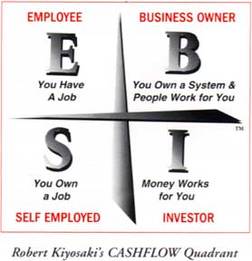
The Cashflow Quadrant is a diagram consisting of the four different types of people who make up the world of business. I must interject a little bit of opinion. This diagram is absolutely brilliant. It is a clear and simple way to understand the four ways in which money is made in America. Kiyosaki says that the people in each quadrant have a different set values which attracts them to that quadrant. He goes on to say that you can always tell the mindset, and values, a person has by the words they use.

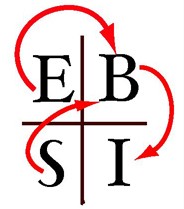
Here's a copy of The Cashflow Quadrant. I'll quickly explain each quadrant.


Left side of the quadrant:

E stands employee – This is your typical 9-5 occupation. These are people that are primarily interested in security. A person from this quadrant can be heard saying the following, “I'm looking for a safe, secure job with good benefits.”

S stands for self-employed, small business, or specialist – These people often say, ”If you want something done right, you gotta do it yourself.” This is where you will find the world's hardcore perfectionists.

Right side of the quadrant:

B stands for big business – These are the people that are primarily motivated by freedom. They say things like, “I'm looking for a great system and great people to work for me.” They are the ones that hire the E's and S's.

I stands for investor – This is the quadrant where true wealth is created. These people invest in the B's of the world. These people say, “I don't work hard for money, my money works hard for me.”

Robert's Rich Dad would warn him to beware of money's addictive power. People don't simply work at their job because of desire or habit. It's more like an addiction. The reason so few people successfully switch quadrants is because switching is akin to breaking that addiction. The effects of the withdrawals are just too powerful.

Here are a couple of important dates that Kiyosaki points out. These events have drastically affected the way money works in America. The first was in 1971. It was in 1971 when President Richard Nixon took us off the gold standard. This meant that the quantity of our money supply was no longer anchored to a quantity of gold. This turned our money into a fiat currency which the government can print at will. The result is, “Savers are losers.”

With the Federal Reserve printing lots of money we see inflation and a declining value to the dollar. For this reason, it is no longer a good strategy to simply save money. A much better idea is to invest your money and, to do that, you need education. Kiyosaki is not a big fan of mutual funds. He views them as very risky. Mutual funds are purchased from salespeople, in the S quadrant, not investors. Mutual funds are sanitized securities that operate by a strategy of diversification (Warren Buffett calls it de-worse-ification.) Buffett and Kiyosaki say the intelligent investor operates with concentration and focus.

A lot of people believe that investing is risky. But, as Kiyosaki is fond of repeating, “Investing is not risky. Being uneducated is risky.”

In actuality, your hand has already been called, and you might not even know it. It is very likely you will need to become an investor. The reason for this is a law Congress passed in 1974 called ERISA. You may not be familiar with the name but you're probably aware of the outcome. Before ERISA we had what are called defined benefit (DB) pension plans. DB plans pay retirees a guaranteed monthly income until the end of their days. After the passing of ERISA, we now have defined contribution (DC) pension plan, such as IRA's and 401(k)s. The pay-out of DC plans are dependent on the preceding pay-in.

What's more, this shift will cause people to be responsible for their own investments. This idea may sound innocent enough but, here's the problem. People will need to begin operating from the I quadrant. Unfortunately, most people do not currently possess the skill set of of an investor (remember how Kiyosaki said that's the problem with mutual funds?) In his book Prophecy, Robert talks about how this shift, from DB to DC pension plans, will result in the, "Biggest stock market crash in history." His predicted crash will result from unskilled, uneducated people operating as investors.

The previous two examples, 1971 and 1974, illustrate the changing landscape of the world of money. We can chose to put our heads in the sand, ignoring what is happening, and hope for the best. Or, we can get involved, participate in the coming changes, and take control of our lives.

The Tax Reform Act of 1986 eliminated most of the benefits that came with being in the S quadrant. And, the E quadrant is an even worst place to get rich. One of the main reasons are taxes. In 1943 the government began collecting taxes through payroll deductions (thank you Milton Friedman.) In this way, the government makes sure they get paid first. The E quadrant really gets hammered. Not only do they pay taxes first. They also have to pay the most taxes, as far as percentages go.

The path that Kiyosaki suggests, for financial freedom, is the following. If you are an E or an S, get yourself successful in the B quadrant. Then take your excessive cash flow and invest in the I quadrant.


The test of a big business is the following: Can you walk away from your business, for a year or more, and come back to find it as successful, or even more successful, than when you left? If you can honestly answer yes to that question, congratulations, you're a successful B!

Kiyosaki also says that the B stands for Bill, Buffett, and Branson. Meaning, people like Bill Gates, Warren Buffett, Oprah Winfrey, and Richard Branson are true B business owners. But, to create a Microsoft, Berkshire Hathaway, Harpo Productions or Vigin would take many millions of dollars, and lots of time. Two resources very few of us have. Luckily Kiyosaki offers an alternative, network marketing. After much research Robert has concluded that network marketing, as known as multi-level marketing, is the best way for most people to follow his suggested path to financial freedom.

Kiyosaki says, "To be successful in the B or I quadrant requires financial intelligence, systems intelligence, and emotional intelligence. These things cannot be learned in school." For financial intelligence one could (and should) study Mr. Kiyosaki. Robert says that one of the main reasons most people never get rich is because they can't gain mastery over their emotions. He says that most people are ruled by fear and greed, which keeps them stuck in the Rat Race. To help gain control over our emotions Kiyosaki suggests reading Emotional Intelligence by Daniel Goleman. I have written an overview of this book. So, if I haven't already, I will soon post it to this blog. In Cashflow Quadrant, Kiyosaki doesn't suggest a book to learn systems intelligence. However, please allow me the liberty of suggesting a book for you. It was written by the MIT professor of management, Peter Senge. The book is titled The Fifth Discipline. Like Goleman's book I have written an overview of Senge's book. And again, if I haven't posted it yet, I will soon.

Mr. Kiyosaki gives financial advice that is quite different from the majority of advisors. I'm talking about people like Dave Ramsey and Suze Orman. They're both into the old school way of investing, the orthodoxy. In the old school it's about saving and getting out of debt. This is probably the best strategy for the majority of Americans. But Robert takes a different approach. Kiyosaki's advice is summed when he says, "Live within your means and then increase your means." Translation, Robert doesn't believe in cutting out that Starbucks latte or whatever. Kiyosaki says he likes driving his Lamborghini and he isn't going to apologize.

The implications of Kiyosaki's Cashflow Quadrant range far and wide. I couldn't possibly explain them all in this short overview. If you'd like further information or clarification just get a hold me me. I'll end with a detailed Cashflow Quadrant:


What can you do with this information right now?

Very simply, embrace the cashflow quadrant. Do whatever it takes to understand and internalize the teachings of this book. You might even have to read the whole book. But, I can assure you it's worth it. Once you comprehend Kiyosaki's genius you will begin to see the world through a completely different lens. One of my favorite quotes comes from the French author Marcel Proust. He said, "The real voyage of discovery consists not in seeking new landscapes but in having new eyes." Remember, money is just an idea. So if you want more money, you need better ideas. Get to become a B business owner. According to Robert Kiyosaki and Donald Trump, the best option for most people, is to join a network marketing company. This way you can keep the job you have, while learning Rich Dad's lessons on the side. If you ask nicely, I might let you join me. :)


Monday, February 24, 2014

Book Review: Rich Dad Poor Dad

This is an overview of the book Rich Dad Poor Dad by Robert Kiyosaki
This is the first book in the trilogy of Rich Dad books.


Kiyosaki's bio: Mr. Kiyosaki is a fourth generation Japanese American who was born in Hilo, Hawaii in 1947. He graduated for from the US Merchant Marine Academy and served as a helicopter pilot in the Vietnam war. Robert is an investor and educator and founder of the Rich Dad company whose stated mission is to, “Elevate the financial well-being of humanity.”

Key point: “The idea that it takes money to make money is the thinking of financially unsophisticated people. Money is only an idea.”

This is a book about personal finance. The book says this about itself, “Rich Dad Poor Dad is a true story on the lessons about money that Robert Kiyosaki learned from his two 'Dads.' One Dad, a PhD and Superintendent of Education, never had enough money at the end of the month and died broke. His other Dad dropped out of school at age 13 and went on to become one of the wealthiest men in Hawaii.”

The first dad, who had the PhD, and worked for the government, was Robert’s biological father. He worked all the time, and yet, was always stressed about money. The other dad, who dropped out of school at 13, was Robert’s best friend’s father. This second dad was able to use the extra time he had, from being rich, to teach the boys as they were growing up.

So the story is a tale of contrasting views towards money. For some, money has a sort of evil connotation. Where the explicit pursuit of money is an unholy act. These are people that might be taking the Bible a little too literally. In Matthew it is written that, "It is easier for a camel to go through the eye of a needle than for a rich man to enter the kingdom of God." Some people even believe that money is the root of all evil. 

Other people take a more receptive approach to money. These people take the perspective that money is something they have always used, and it is something they will always use. So they figure they might as well learn about it.  Kiyosaki was able to study both sides of the equation and has decided to go with the latter. That is to say, Robert listened to his rich dad. This book details the beginning of Robert's financial education.

As a youngster Robert was taught six lessons about money. And these six lessons now form the core of his book. I will briefly discuss each one. By the way, the lessons Kiyosaki teaches are the lessons of his Rich Dad so I use the two names interchangeably.

Lesson One – The Rich Don't Work for Money
Kiyosaki says, “The poor and the middle class work for money. The rich have money work for them.” Robert says that most people are stuck in what he calls the Rat Race. The reason for this is most people are hamstrung by their lack of control over their emotions. Rich Dad would say, “The pattern of get up, go to work, pay bills, get up, go to work, pay bills ... Their lives are then run forever by two emotions, fear and greed. Offer them more money, and they continue the cycle by also increasing their spending. This is what I call the Rat Race.”

Lesson Two – Why Teach Finanical Literacy?
“Intelligence solves problems and produces money. Money without financial intelligence is money soon gone ... Rule One. You must know the difference between an asset and a liability, and buy assets. If you want to be rich, this is all you need to know. It is Rule No. 1. It is the only rule.” The definitions are really quite simple. An asset is anything that puts money into your pocket. A liability is anything that takes money out of your pocket.

Lesson Three – Mind Your Own Business
Rich Dad taught Robert that if he wanted to become rich he would need to own (mind) his own business. “For adults, keep your expenses low, reduce your liabilities and diligently build a base of solid assets.” This doesn't mean you can't have nice stuff. It simply points out, “An important distinction is that rich people buy luxuries last, while the poor and middle class tend to buy luxuries first,” on credit. Rich Dad would say, “Let your assets buy your luxuries.”

Lesson Four – The History of Taxes and the Power of Corporation
“The reality is that the rich are not taxed. It's the middle class who pays for the poor, especially the educated upper-income middle class … Employees earn and get taxed and then try to live on what is left. A corporation earns, spends everything it can, and is taxed on anything that is left. It's one of the biggest legal tax loopholes that the rich use.”

Lesson Five – The Rich Invent Money
There are many ways the rich invent money. One example would be to purchase raw land, get it rezoned and sell it to real estate developers looking to build homes or a shopping mall. Another way is trading stocks, in particular, buying stocks of a pre-IPO company. Unfortunately, many of the best stocks aren't available to the average investor. In an attempt to curtail junk bond salesmen the SEC created a classification system for securities. The result was that it now requires too much work for most pre-IPO companies to seek investments from average investors. It usually makes more sense to go to a syndicate of “sophisticated” investors. (note: the Jobs Act of 2012 has changed this)

Lesson Six – Work to Learn – Don't Work for Money
Rich Dad would often say that it isn't money that makes you rich, it's business skills. And, the single most important business skill is selling and communicating. It is for this reason that Kiyosaki often recommends a network marketing company, also known as multi-level marketing. MLM's focus on training and developing their people. Specifically in the areas of selling, communicating, and leadership. So, first wealthy people learn and develop the skills. Then they get the money. The poor want to be paid while they're being trained.

Kiyosaki sees five main obstacles, that people must overcome, if they wish to be rich. They are: fear, cynicism, laziness, bad habits, and arrogance.

To get us moving, Robert concludes by saying, “I offer you the following ten steps as a process to develop your God-given powers.”
1. I need a reason greater than reality – The power of spirit.
2. I choose daily – The power of choice.
3. Choose friends carefully – The power of association.
4. Master a formula and then learn a new one – The power of learning quickly.
5. Pay yourself first – The power of self-discipline.
6. Pay your brokers well – The power of good advice.
7. Be an “Indian giver.” - The power of getting something for nothing.
8. Assets buy luxuries – The power of focus.
9. The need for heroes – The power myth. Emulate your heroes.
10. Teach and you shall receive – The power of giving.

I'll end back where I began. Many people believe it takes money to make money. Kiyosaki thinks this is foolish. “The idea that it takes money to make money is the thinking of financially unsophisticated people. Money is only an idea.” To make more money takes better ideas. Kiyosaki would say we derive betters ideas from being more educated. Specifically in the area of financial intelligent.

How can you use this information right now?

Mind your own business. If you don't already own your own business you need to. ASAP! According to Robert Kiyosaki and Donald Trump, the best option for most people, is to join a network marketing company. This way you can keep the job you have while learning Rich Dad's lesson on the side. If you ask nicely, I might let you join me. :)


Monday, February 17, 2014

N = 1


We've all heard the saying, “If you don't learn from history, you're bound to repeat.” This post is all about learning from history. I was thinking of naming this post, “Live Experimentally.” But I really like the elegance of N=1. N=1 is about self-experimentation. Although, you can do what you want, I'm not really talking about, “Sex, Drugs and Rock 'n Roll.” I'm talking about everyday stuff. I'm talking about learning from our experiences so we can repeat the ones that work and fix the ones that don't.

Is it coincidental that the words “experience” and “experiment” are so similar? Definitely not. I saw an article, on the website of the Worcester Polytechnic Institute, that said, “An experiment is what you do to investigate something. It is the process by which you learn something … An experience is something that happens to you.” As you can see, the only really difference is the intent. If your goal is to learn something, you're leaning towards an experiment. If you're just coasting, and letting things happen, you're in the realm of experience. Both are useful. But, again, this post is about learning. So, we need to learn how to set up an experiment.

As you probably know, the letter N denotes the sample size in a scientific experiment. N=1 means a self-experiment. We most certainly cannot draw general conclusions from self-experimentation. However, we can definitely increase our effectiveness. The goal of N=1 is to become more effective. It's not to figure out some advice that we wish to impart on others. For the most part, you're probably going to want to keep your results to yourself. So, let's take a step back and review the scientific method.

I won't get real deep into it, let's just keep it simple. Science is fueled by curiosity. The first step is experience. Experience is an integral part of experimentation. Through our experiences, and observations, we wonder about the way the world works. We do a little bit of investigation so we can establish our viewpoint. This is our hypothesis. If we're smart, we test our hypothesis by running an experiment. Then we review the outcomes (the data) of our experiment to see if the hypothesis was wrong (you can never really prove that a hypothesis is “right.”)

If the hypothesis is proven to be incorrect, we throw it out and come up with a new one. That is to say, we come up with a new theory. Conversely, if the hypothesis is supported by the evidence, we want to tweak one variable and rerun the experiment. This is critically important. Ultimately what we looking for is something called the “mechanism.” I won't get into it other then to say that you want to change your variables one at a time. This will allow you to establish which is the key variable. What we're looking to do is distinguish between correlation and causation. Meaning, it decipher between what is cause versus what is merely connected.

This is something we all do rather intuitively. Let me give you an example. For the most part, people get sun-burned when it's warm outside. So, if we don't know how isolate our variables, we might think that warm weather causes the skin to burn. Of course, all we have to do is change one variable at a time to see if that hypothesis (warm weather burns) is accurate. A simple way of doing this would be to wear the same clothes, on a different warm day, and stay out of the sun. It doesn't take long to figure out that the sun is the culprit. The sun is the mechanism that burns skin. Had we put on a lot on clothing AND stayed out of the sun, we wouldn't know which is which. Changing two variables is of no help.

In the jargon of science, warm weather is correlated with burnt skin and the sun causes burnt skin. This is a distinction that messes a lot of people up. Of course, I intentionally used a very simple example to illustrate the point. We all know that warm weather doesn't cause sun-burns. You don't have to understand electromagnetic radiation to know that the light, coming from the sun, is what fries our skin. Incidentally, I am, in no way suggesting that you stay out of the sun. Sensible sun exposure is an important part of overall healthy living.

What I'm saying is to live experimentally. Practice is pretty much all that's required. With time, it becomes second nature to isolate your variables. Of course, sometimes changing one variable at a time is impossible. But there are all kinds of ways to construct personal experiments to figure out what's working, in our lives, and what's not.

I guess there's something of a paradox here. In science you generally want N to be as big a number as possible. In other words, you want as large a sample size as possible. Statistics teach us that the larger the sample size, the more reliable/accurate the data. However, if you know how to conduct proper experiments, and not be fooled by chance, you can get the best information from N=1. So, good luck and happy testing.


Monday, February 10, 2014

Don't Trust Yourself


I guess I'll go ahead and clarify, a little bit, right off the bat. More thoroughly, the title of this post probably should have been, “Don't always trust yourself.” And, it's good advice. Sometimes we should, indeed, trust ourselves. But, not always. You see, a lot of people seem to be very proud that they, “Go with their gut.” And I would agree that instincts, or gut feelings, are often accurate. But, they're often wrong, as well. Let me explain.

Many years ago, psychologist Aaron Beck founded a scientific discipline called Cognitive Therapy. One of the many things Beck did was identify a phenomenon that he called a “Cognitive Distortion.” It's not a term we hear every day but, perhaps we should. It's a really important idea. Instead of using the technical, psychological jargon, let's just call it a “Thinking mistake.” The fact of the matter is, we humans make thinking mistakes all the time (humbling though that may be.) In fact, we often make these mistakes in regular patterns. So much so that Dan Ariely felt inclined to write a book titled Predictably Irrational. It's a jolly good read. If you haven't read it, I highly recommend doing so.

Any how. The thinking mistake that has been on my mind lately, is something Beck would call, “Emotional reasoning.” The thought process, behind emotional reasoning, goes something like this, “I feel it, therefore it must be true.” For example, let's say you totally over sleep one day. You wake up and frantically run around the house trying to get the kids ready for school. The thoughts swirling in your head are, “How could you do this? You're such a bad mom. This kids are counting on you and all you can do is selfishly snore the days away. You should be ashamed of yourself!”

This is an example of emotional reasoning. That morning, when you looked at the alarm clock and realized your kids were an hour late for school, you started to beat yourself up. You went so far as to label yourself a bad mother. The reasoning was emotional. It goes something like this, “Oh, I feel so guilty, I must be a bad person.” You see, a lot of people, when they feel the emotion of guilt, automatically assume they must have done something wrong. So, you scurry around the house throwing sharp, mental daggers at yourself. You get so caught up in your self-imposed torture that you can't even hear your children trying to tell you it's Saturday.

Now, that might seem like a silly example, and perhaps it is. But these sorts of scenarios are all too common in modern life. The following is how the book Thoughts & Feelings explains emotional reasoning, “You believe that what you feel must be true-automatically. If you feel stupid or boring, then you must be stupid and boring. If you feel guilty, then you must have done something wrong. The problem with emotional reasoning is that our emotions interact and correlate with our thinking process. Therefore, if you have distorted thoughts and beliefs, your emotions will reflect these distortions.”

In the example of the late-rising mother, the problem was her assumption that it must be a weekday. Which is a totally understandable assumption, seeing as the majority of days (71%) are weekdays. It just so happens that this particular day wasn't one of them. It was a Saturday and there was no school. I used that example because it's innocent enough. However, as it turns out, these sorts of thinking mistakes are quite common. And so, we need to be on-guard against them.

One place where it's most obvious that we shouldn't always trust ourselves is with our diet. This is a realm that often leads to some rather delicious paradoxes. One thing I often say is, “I love dessert. That's why I don't eat it.” Get it? It's a total paradox but it makes sense, doesn't it? It's easy to get carried away eating sugary treats. My love for desserts keeps me on-guard against them. It's not that different from how an alcoholic should not go into a bar. Just because we feel like eating or drinking something, doesn't mean that we should. Again, it's not always a good idea to trust your feelings.

One of Aaron Beck's students was a gentleman named David Burns. Dr. Burns says that procrastination is one of the most common side effects of emotional reasoning. Which makes all the sense in the world. I can tell you this, I don't know that I've ever felt like taking out the garbage. And I've damn near earned a PhD in procrastination. But, it must be done, so we do it. Right?

Another psychologist, David Reynolds, puts it like this, “The mature human being goes about doing what needs to be done regardless of whether that person feels great or terrible. Knowing that you are the kind of person with that kind of self-control brings all the satisfaction and confidence you will ever need. Even on days when the satisfaction and confidence just aren’t there, you can get the job done anyway.”

Maybe that tag, those three words, will sick in your head. Don't trust yourself. (Three more common words would be Do It Now.) I mean, you shouldn't, necessarily, listen to your feelings. Sometimes ya gotta do what ya gotta do. You have to force yourself. Get out of your comfort zone. Like meeting new people. It can be quite uncomfortable. But that's certainly no reason to not do it. (Are double negatives allowed? I always forget.)

I think this whole listening-to-your-emotions thing was parodied beautifully in that Sprint commercial with James Earl Jones and Malcolm McDowell. You know the one? The one where they reenact a text conversation between two guys named Chris and Craig. “I'm kinda tired, but I also kinda wanna go out … Me too!! ….Well, text me if you do … K. But, I probably won't. But I might.”

Too funny!!

Have a good one :)

Monday, February 3, 2014

Embrace the Genius


Let me ask you a question, is life a marathon or a sprint? I'm being serious. What do you think? Is life like a sprint or a marathon? Please take a minute and think about it. You probably don't need much time. I have to imagine that you answered the question, in your mind, immediately after you read it. But, perhaps, you waffled. Maybe you rethought the question and began to come up with good arguments for either answers. Let's talk about the answer. But first, let's take a step back.

Last week I posted an idea from the book Good to Great. Specifically, I talked about something Jim Collins had named "The Stockdale Paradox." And this week, I figured I'd mention something from another of Collins' books, Built to Last. If you have no idea what I'm talking about go here: My Favorite Subject

As the title of this website suggests, I think and study a lot about paradoxes. And it's not because I'm a glutton for punishment. But rather it's because paradoxes are central to life. F. Scott Fitzgerald was essentially speaking about the paradox when he said, “The test of a first-rate intelligence is the ability to hold two opposed ideas in the mind at the same time, and still retain the ability to function.” Now, I'm not saying I have a first-rate intelligence, but I am working on it. :)

Built to Last is an excellent book and I highly recommend it to you. I'll probably end up posting a report about the entire book. Or, I might just take the concepts one at a time. I haven't decided yet. But I have been fortunate enough to work with Collins' co-author on some of the concepts in Built. One concept, in particular, has been ringing in my head lately.

Built to Last is a book about the successful habits of visionary companies. In their research, what Collins, and his co-author Jerry Porras, discovered was that visionary companies do not oppress themselves with what the authors call the “Tyranny of the OR." The "Tyranny of the OR" is the rational view that cannot easily accept paradox, that cannot live with two seemingly contradictory forces or ideas at the same time. It pushes people to believe that things must be either A OR B, but not both.

“It makes such proclamations as: You can have change OR stability. You can be conservative OR bold. You can have low cost OR high quality. You can have creative autonomy OR consistency and control. You can invest for the future OR do well in the short-term. You can create wealth for your shareholders OR do good for the world.” That last one is actually pretty popular these days. It's the idea behind, “Doing well by doing good.” A great example would be Yvon Chouinard and what he's doing with Patagonia.

Collins and Porras found that instead of being oppressed by the “Tyranny of the OR,” highly visionary companies liberate themselves with the “Genius of the AND.” This is the ability to embrace both extremes of a number of dimensions at the same time. “Instead of choosing between A OR B, they figure out a way to have both A AND B.”

This isn't about greed but rather it's about wisdom. Automobile manufacturers used to believe that you could either produce a low-cost car OR a high-quality car. And that's exactly what they did. But then one company wondered if they could do both. Before long, Toyota had taken over and was in first place. Today it's well accepted that we can have low-cost AND high-quality. In fact, in many ways, high-quality IS low-cost. What we find is that higher quality goods actually cost less. It's like my pappy used to say, “Anything worth doing is worth doing right the first time.”

Let's take it off business for a minute. Let me ask you this, would you consider yourself Dr. Jekyll or Mr. Hyde? By making the question personal, I hope to have illustrated the point. The answer, that I imagine you gave, was something like, “It depends.” And, yes, it does depend. You're probably more Jekyll than Hyde but we all have the ability to be both. We're good AND we're bad. If you doubt me, or if you're in denial, I encourage you to read the book The Lucifer Effect by Phil Zimbardo. The book is about the famous Stanford prison experiment and it clearly illustrates how each of us is part Jekyll and part Hyde. My friend, don't fight it. It is what it is. Embrace the genius of AND.

Let's finish back where we started. What was the question I first asked you? Is life a marathon or a sprint? What is your answer now? Surely, your answer now is that life is both a sprint AND a marathon, right? I believe that's true. I believe it's wise to view life as a marathon of sprints. “Hurry up and wait,” right?

I do think the marathon element is the more fundamental of the two. But both are important. Grit and perseverance are critically important in life. However, procrastination is also an ever present enemy. This is where the sprint comes into play. Sometimes we need to get off our butts and sprint. It's how great things get done. Of course, we can't sustain a sprint indefinitely. So, sometimes you need to sprint and sometimes it's okay to walk. New York psychologist, Nando Pelusi, likes to use the word “Kurtosis” for this process. Dr. Pelusi advocates a strategy of brief intervals of passionate, intense activity dispersed among periods of conscious relaxation. Basically, a marathon of sprints.

P.S. I highly encourage you to read the book Built to Last. It's quite impressive and it launched Collins into an extremely successful career. You've probably heard Jim's name before. But, the name you definitely hear the most, on this blog, is Peter Drucker. Here is what Collins had to say about Peter, “My first encounter with Drucker's impact came at Stanford in the early 1990's, when Jerry Porras and I researched the great corporations of the twentieth century. The more we dug into the formative stages and inflection points of companies like General Electric, Johnson & Johnson, Procter & Gamble, Hewlett-Packard, Merck and Motorola, the more we saw Drucker's intellectual fingerprints. David Packard's notes and speeches from the foundation years at HP so mirrored Drucker's writings that I conjured an image of Packard giving management sermons with a classic Drucker text in hand. When we finished our research, Jerry and I struggled to name our book, rejecting more than 100 titles. Finally in frustration I blurted, "Why don't we just name it Drucker Was Right, and we're done!" (We later named the book Built to Last.)” I'm just sayin'.